
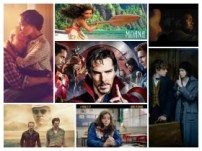
Emboldened by the Thanksgiving holiday, Amy and I saw seven films in the theatre in nine days in late November. The journal app where I’d been keeping notes on films tanked after an iOS upgrade several months ago, so that’s a good impetus to keep such notes here, instead, where they truly belong anyway.
Films I saw in 2016 that I’d like to make at least a brief note about, in no particular order other than saving two for last:
Hell or High Water: This is a superb film, perhaps as good as any I saw this year. It’s like a throwback to films from the 70s—interesting characters sketched within an action/caper narrative (remember those? I barely do). An excellent performance from Chris Penn; who knew? A+ (I don’t usually rate/grade films, but since I’m discussing several of them here, I might as well do)
Lots of Marvel superhero movies, including Deadpool, X–Men: Apocalypse, Captain America: Civil War, and most recently, Doctor Strange. The secret superpower of Marvel producers remains casting, including, of course, Benedict Cumberbatch. Another element that sets Marvel apart from DC efforts, and indeed from nearly all contemporary action movies, is that I can often meaningfully manage to visually parse the action scenes themselves. I’m not exaggerating here—I cannot, in most cases, understand who’s moving where, who’s striking out with what, where the camera is, where the ground is, what I’m supposed to be seeing onscreen. Suicide Squad, for instance, which turned out to be not nearly as bad as many people suggested, because it had some interesting characters, was significantly undermined for me by the fact that I could not follow anything that was happening in any of the action sequences, ever, so I just stared blankly at the screen and waited for them to end so the conversation scenes could begin again, like some bizarre inversion of recitative in opera. Marvel handles this more effectively to a reliable degree. I might, in light of this, ever actually deign to watch the second iteration of the Guardians of the Galaxy nonsense, as long as I’m authorized to eat a whole thing of FaveRED Starburst Minis during the experience. A for the batch overall
Don’t Breathe: A very compelling premise, cinematically, for me as a thriller/horror fan. Alas, flatly and bluntly predictable in every way, narratively, for me as a thriller/horror fan, and socially and politically repugnant, thematically, for me as a person attempting to have a critical thought about the world. C-
The Edge of Seventeen: I was excited to see this because of Hailee Steinfeld, who was brilliant in True Grit. The film took me back to the experience of high school like the best John Hughes marathon would, and it had some quirky characters and fun situations, but in the end all I really came away with was, sure enough, Hailee Steinfeld’s performance. B+
And while I’m on the subject of superior actors who I’m old enough to have fathered and about whom I therefore try to sublimate the romantic hearts I feel into chaste admiration for their acting craft: Madame Oscar herself, the Breathtaking Ms. Larson, will apparently next grace our screens in—King Freaking Kong???!!!??? I hope that money truck was very, very full indeed, Brie, and I hope it allows you to take any real, quality roles you like for the foreseeable future.
Loving: An interesting and well–timed story. Extraordinarily slow in pace, but it’s clearly a deliberate aesthetic, and an appropriate one. Edgerton, who often annoys me, was a surprisingly excellent choice. A-
Moonlight: Magnificent. There should be a parallel to the Bechdel test, perhaps called the Rock test in honor of Top Five, a film that should have felt ordinary but instead felt like a masterpiece simply because of these factors: The film must have (1) at least two men of color who (2) talk to each other about (3) something other than women or their money–making schemes. It’s staggering how audacious this film feels just because it takes for granted that onscreen, too, the Lives of Black Men matter. A+
Fantastic Beasts and Where to Find Them: I was skeptical and not enthused about seeing this; I didn’t read the co–created book from last year, either, because I am the kind of Potterite who doesn’t want ancillary stories and such to muddy my memory of the world of the Magnificent Seven novels. Then Amy said Rowling wrote the screenplay, though, and I said meh, and she said we’re going, and I said okey–doke and also I’m buying Starburst Minis. It turns out that I didn’t need them in the slightest—all the yumminess that could possibly be consumed was there in the film itself, which felt in every way like a worthy story from my memory of that world. I’ve always had a crush on Sam Waterston, even back when I was much too young to recognize it as a crush like when I was a 13–year–old spending my summer days off from school watching The Killing Fields on VHS (I’m not kidding), and it’s great to learn that he has a kid who’s equally delightful. I’d noticed her a bit in that mediocre Anderson film Inherent Vice, but this role was perfect for her. A
Arrival: I will discuss this film in detail in a separate, forthcoming blog entry. A+
Moana: I teach classes in which we address gender, social norms and mass mediated messages, so I have read a large quantity of writing at all levels on the topic of Disney princesses who are always on–the–way–to–being–safely–wed, no matter how young or confused or actually completely asleep they might be at the moment. I was excited to see this film because of the music, as I am convinced that on my deathbed I will be able to recognize that Hamilton: An American Musical was quite clearly the most significant performing arts event of my lifetime, and I thought it might be visually impressive given the oceanic setting. The music is good, though the visual palette is ordinary at best by current Disney standards, but I dearly love this film for three reasons: (1) The lead character, in contrast not only to the much–criticized passive maidens but also to their more progressive (in some ways) parallels in The Princess and the Frog, Brave (not exactly a Disney film, I recognize), Tangled and Frozen, is not defined relationally at all. She is a person, interested in the world in the same ways that people are interested in the world, no more and no less. It’s astonishing how refreshing this feels. (2) The film is thematically pedagogical—in it, characters explore their relationship to the environment, to their histories, to myth and its role in framing expectations, to possibilities for taking action and effecting change. (3) The dimension of this film that truly, above all, kindles the spark in that part of me that still yearns for the nostalgic, childlike, corporate, overdetermined, brightly colored, fabricated smell pumping, mystery inducing, fun, exploitative, theme park and mouse ears site where my love and I found one another, Disney: the film is narratively pedagogical—what leads characters to make choices, what leads events to follow upon one another, what spurs transformations (SPOILER ALERT) from god to island to monster and back again is always, in each case, someone learning about the world, about others, and about themselves. There are no villains of any kind inciting narrative flow, save the weird little pirates who mirror nothing so much as the mechanical, inexorable vigor of the cyclical death–amid–life force. This may not be the most musically or visually impressive Disney film; it must be, without even a close comparison, the most intellectually compelling Disney film, ever. A+
 Selling Dust