
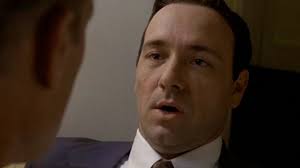
 “Spoiler Alert” would be, here once again in my blog, a gross understatement: It’s been two full decades since the release of L.A. Confidential, so you’re wildly late if you haven’t seen this magnificent film yet—and despite the fact that, like The Sixth Sense, L.A. Confidential has no trouble whatsoever withstanding repeated viewings even when you know every line by heart, reading this entry will rob you of the exhilarating opportunity to have revelations creep up on you as they are intended to creep.
“Have ya a valediction, boyo?”
“Rollo Tomasi.”
I suggested on Facebook a while ago, in response to Zaki posting this pair of lines from L.A. Confidential, that this might well be my single favorite exchange of dialogue in all of cinema. I acknowledged then that such a choice of favorite might feel strange or a bit precious, similar to my film critic idol Robin Wood choosing Rio Bravo as his single favorite film near the end of his life; like Wood, I’m a college professor who knows a fair bit about the history and culture of cinema and who publishes scholarly criticism about artists from “popular” media who are linked to high culture and thereby “elevated” (in my case, Bob Dylan). Shouldn’t I have seen enough film to favor a piece of dialogue from Bergman or Renoir, something less Hollywood, less mainstream?
Since authoring that comment I’ve had some time to chew on this claim and to rewatch the film, and I’ve decided that not only is this, indeed, my choice for “greatest exchange of dialogue I’ve seen in cinema” but that, perhaps even more impressively, the exchange functions as a perfect epitome, a perfect miniature, a true microcosm—not only of everything I love about the film for which it is a narrative fulcrum (a mere 25 minutes from the end of the film!) but of everything I love about great cinema writ large. I can trace in this one single exchange a host of sparkling cinematic features that burn at the core of the art form, and that’s what I mean to do here.
I picked up the notion of the “epitome” from my essayist idol, Stephen Jay Gould, so following his lead here I’ll first itemize the dimensions of the argument, then make the argument in the essay itself. These are the qualities of the “valediction” exchange that epitomize great cinematic dialogue for me, that exemplify why and how dialogue can be a vibrant force of aesthetic nourishment within powerful cinema, ordered from most to least obvious:
1. The exchange is a “shock” to us as a viewer, following immediately on the heels of a distinct visual shock
2. The exchange is a pivot on which the entire plot turns, again immediately following another pivot point that spurs it
3. The exchange is an example of an unanswerable question put to someone who, against all odds, finds not only an answer but the perfect answer given the situation
4. The exchange includes a dying declaration, an impromptu valediction—interesting cinematically on its face but in this case also a declaration that will ensure the matching death of the Other
5. The exchange sculpts the character of each of the two interlocutors with incredible precision, being almost certainly the most richly personal utterance either of these two central characters offers during the entire film
6. The exchange gives each actor an opportunity to shine in performance
7. The exchange depends on and thereby illuminates human motivation and human resourcefulness
8. The exchange moves us nimbly between visual communication and verbal communication
9. The exchange pivots the mode of suspense that grips us and that binds us to the film; as audience members we engage the film differently from this point forward in terms of how we relate to the characters
10. The exchange exemplifies the power of the symbolic, both within the narrative and in the cinematic form
1. We’ve just been shocked, in the very instant precipitating this exchange, with the revelation that Smith is somehow deeply involved in the nefarious, still–murky (for us and for the protagonists) business of the Meeks murder and the mysterious Night Owl Massacre of Stenslund, Lefferts and others—involved enough that when Vincennes takes the chance opportunity to pop over to Smith’s house (because Exley has stood him up to instead be intimate with Bracken), his pop–over whim leads to his being murdered by Smith to keep him silent (especially from relating what he’s learned about Meeks’ identity and background to Exley). I deliberately write all of this out to illustrate how complex this film is on the level of “plot,” but one beautiful aspect of L.A. Confidential‘s cinematic craft is that all of what I write here is lucid and sensible to a viewer on the very first viewing—small details may become more cogent on repeated viewings, but all of what I describe above is evident to the viewer simply through having lived with these characters and seen and heard what they’ve seen and heard. Such impressive cinematic narration, unfolding at a natural, human pace of interaction, allows for the powerful visual shock of Smith’s whirling shot–to–the–heart; we’re as caught off guard as Vincennes because we’re coursing through the depths of this complex flow along with him, puzzled but persistent until this moment of undoing. Achieving a genuinely shocking moment (as opposed to something jumping out from behind a curtain like in dull horror films, a hackneyed cinematic cheat) like Smith’s gunshot is impressive enough, rare enough, and even in those few films that accomplish such a genuine shock we’re typically left gathering our wits to come to terms with it in its cinematic aftermath. But here, superbly, we are immediately shocked again: The initial shock results in the ensuing dialogue, the “valediction” exchange, not anticlimax or emotional rebound but another shot directly to our audiencing hearts as Vincennes replies. To create for us two distinct but successive shocks with this level of force, within a narrative this dense and driven, is a stunning artistic accomplishment. And it’s made possible by the deft layering of experience, scene by scene, that has guided us precisely through this labyrinth and thus prepared us to grasp the brilliance and import of Vincennes’ reply; we’ve felt the belly lurch at his sudden betrayal and death, but now we ride back up seconds later, not simply borne back aloft on these cinematic rapids but thrust fully and vertiginously above the spray as the line “Rollo Tomasi” sinks in. That’s what great cinema is supposed to do.
2. The exchange does what strong dialogue should do, must do if a film is to avoid dull exposition and thereby distinguish the art of cinema from literature: it acts simultaneously as drama and as plot fulcrum. I’ve never been especially enthusiastic about films with voice–overs because I feel like it’s cinematically cheating, letting us into characters’ heads as novels do, and whether you agree with me about voice–overs or not the “valediction” exchange epitomizes its opposite. Smith in the moment of the gunshot is revealed as a crook, information that would merely die with Vincennes—he’s not yet an antagonist in the narrative flow the film has created, even after the gunshot, but merely another piece in the gradually solidifying puzzle (if a central one). But in the moment of direct conflict, in his need to not only fire the scalding metal into Vincennes’ heart but to twist it emotionally as if it were a knife blade, Smith is rewarded (and we are rewarded) with the heightening drama he creepily insists on creating: His reward for his unnecessary verbal engagement of Vincennes is to move himself from the shadows of our narrative, from its periphery as he’s nimbly kept himself for more than 100 minutes of film, into the spotlight, into the role of primary, visible antagonist for the film’s balance. Dramatic and narrative arcs become inexorably fused in this exchange. That’s what great cinema is supposed to do.
3. Smith puts a question to a man on the brink of death, a man he’s just now betraying and murdering, a man over whom he has always had institutional power that he has secretly wielded to his own benefit. Given that context, any question he puts to Vincennes ought to be unanswerable—not merely “rhetorical” in the sense of a question lacking authentic interrogative will, but unanswerable in the much deeper sense that questions asked in torture exchanges are unanswerable because the respondent has no agency from which to answer. Yet, stunningly, Vincennes manages in this impossible position to put not only a true answer to Smith (how do we know it’s a “true” answer? Smith takes it seriously, takes it up as if it is information in the very next scene with Exley) but an answer providing exactly what has been requested: A valediction. A valedictory statement is, after all, an utterance that seals an end by pointing toward what can come, paradoxically, after that end. Therein lies the brutality of Smith’s question, tormenting Vincennes with the word “valediction” because he assumes a dying person suffering both physical and emotional shock (just as we are experiencing both visual and verbal shock in this moment) cannot see past his own life’s end. But with the power of cinema, we can see past Vincennes’ end, and what we will see, in these remaining 25 minutes of film, is figured entirely by Vincennes, ghost–like, through his reply. In the penultimate scene, after the shootout at the Victory Motel, Exley tells a confused Smith that he, Smith, is Rollo Tomasi because he is “the one who gets away with it.” In some ways Smith does get away with it, given how Exley chooses to bring closure to the case within the world of the story, but despite this, despite the fact that Exley himself invented the very name Rollo Tomasi, Exley is not the author who assigns this name to Smith—Vincennes does that, in his response to the “valediction” question. Vincennes, a character within the tale, authors in a compelling sense nearly everything that remains in the film, brings it all about in his dying utterance, somehow impossibly finding the valediction that Smith requests. In that way Vincennes the “author” makes the film’s end feel as far away as a fictional piece of narrative can get from the deus ex machina charge, makes it feel like events unfold not because they play dramatically but because they are the outcome of drama. That’s what great cinema is supposed to do.
4. “Rosebud,” for all that it is endlessly parodied in film culture, became famous for good reason: A person’s dying words captured on film are in many ways the very essence of the art form. Cinema is a chain of moving images (and, lately, sounds) selectively framed and selectively focused and selectively cut into sequence, paralleling in form the stitching together each of us does for ourselves in creating the fabrics of identity and memory. I suggest that in this respect the camera filming a person dealing with her/his own death in some way—when that person, those gathered in the frame, and we the audience all know the person is on the brink of death—offers a unique opportunity for the cinematic form to bring us close to that stitching process of identity and memory creation. This works, aesthetically, best of all when the person who is dying seeks to make sense of her/his own death in response to the immanent dramatic world onscreen. Vincennes, in the “valediction” exchange, faces as extreme an example of “immanent dramatic world” as there is: He’s just been murderously betrayed by a person he trusted. His utterance is in this sense a response not only to Smith’s question but, at the same time, to his existential condition at its barest level. Like CF Kane, like all of us, he must confront his imminent death alone, a point made within my favorite film, Donnie Darko (“every living creature on Earth dies alone”). But somehow, his ought–to–be–impossible valedictory retort grasps at Smith like a tormented, writhing person in metaphysical quicksand, like Don Giovanni being dragged to hell by the statue, and he manages with “Rollo Tomasi” to find purchase—he drags Smith to hell with him, refusing to go gentle into that existential night. It takes a few more hours, and it takes help from White and Exley, but he drags Smith down with him, refuses to die alone. Now that’s a valediction, enacted on film before our eyes. That’s what great cinema is supposed to do.
5. In the same way that dialogue and action, rather than exposition (and especially rather than voice–overs) should drive a film plot, dialogue and action rather than exposition should sculpt character. In this single moment of dialogue, Smith’s character, previously soft outlines of “old boy” tough–but–politically–savvy captaincy, emerges in the “valediction” exchange in sharp chiaroscuro as seething evil of the most cynical order. This does not happen gradually, it happens all at once, and the force thrusting Smith into stark relief is not primarily the force of the gunshot but the force of the question. His “Have ya a valediction, boyo?” line retains the casual, old–world chumminess of the Irish drinking buddy even as he cruelly taunts a suffering, bleeding friend and colleague whom he has welcomed into his own home only minutes before. And the question may not only be a taunt; Smith has relied for many years on privileged information to execute (pun intended) his will, we now suddenly realize, and he cannot resist the urge to squeeze whatever he can out of the crumbling husk of Vincennes. This distinctive, memorable combination of glib charm and icy viciousness, the paired traits vital to his accomplishments as the film’s overarching criminal mastermind, is nowhere conveyed in the act of the twirl–and–fire, which does its more limited part in molding the aging Smith as a lithe practitioner of weaponry excellence and impressive fitness (in contrast to Meeks and Stenslund, who he mocks as out of shape multiple times); it’s conveyed entirely in the one line of dialogue. This one line makes the later smothering of Sid Hutchins, and the visual wink of Smith’s donning of a black leather glove to do the act, overdetermined; these are the actions of a man we have already come to know well enough to expect this from, entirely because of one line of dialogue. In contrast, we know Vincennes quite well before he sets foot in Smith’s house that night; we know full well by now that he is ruthlessly cunning in his efforts to draw personal benefit (monetary; social; professional; sexual) from any and every situation he encounters. But what has brought him to Smith’s house? His burgeoning conscience. He’s feeling directly responsible, in some way he cannot articulate because the causal factors remain cloudy, for the death of the young actor he (minimally) helped to set up with the DA and also, as a result of Exley’s insights, indirectly responsible for the events associated with Bloody Christmas and the quick “solving” of the Night Owl Massacre. So he’s evolving morally, like all good characters do, over the course of the film. Yet here, in response to an act and a question from a character, Smith, whose entire (im)moral sense is now flooding over both him and us as viewers with nauseating waves, Vincennes does something that might be his greatest moral act as a cop (a job he “cannot remember” a reason for taking up), ensuring the fall of the hidden kingpin Smith—and he manages this great moral act by drawing on his most devious, most inhuman resource, his ear for information that can personally benefit him if deployed in the most temporally and contextually precise of needle threads. It’s not only true that any other character in this film having a retort that shatteringly perfect would stretch the limits of credulity and risk taking us out of the diegetic world of film in recoil against the screenwriting; any other character I know in film history wouldn’t credibly summon that name, right then, on the point of death itself (and yes, I include in that assessment another, much more famous, Spacey character from this cinematic era, Kaiser Sose; I warrant that Jack Vincennes is more clever than Verbal Kint/Kaiser Sose, and I’m dead certain that L.A. Confidential is a better film than The Usual Suspects by a good margin, as I hope the present entry sufficiently demonstrates). But we’ve been prepared for Vincennes to be the one who can do it, for 100 minutes now; he’s the guy, no doubt in our minds in this moment. Even Smith himself knows it’s true, or should know despite his arrogance befuddling him in this moment, as his line from early in the film shows: “Jack, I doubt you’ve ever taken a stupid breath in your life; don’t start now.” Smith has left him exactly one remaining breath, and Vincennes proves him right: it’s a breath that could not possibly be further from stupid, crumbling husk or not. We’ve been prepared for that moment of unparalleled genius, prepared to accept it and behold it for what it means about Vincennes and what it means about Smith by all of the sketching the film has done to this point, and now, as he offers his valediction, as he takes his final breath, every detail of Vincennes is complete in this extraordinary portrait even as the textures of Smith are filled in at the same moment. Vincennes, fully portrayed now, is nothing if not glibly charming and icily vicious himself—but DAMN if he didn’t meet a match in those traits that he couldn’t hope to best in this, his final moment. Or could he? Great dialogue should work like the deft charcoal pencil of the world’s greatest caricaturists, swiftly shading in only one set of call–and–response—just as the “valediction” exchange does. That’s what great cinema is supposed to do.
6. Cinema gives us the close–ups that the stage cannot, allowing us to witness a different kind of thespian craft dependent on subtle flicks of the eyelids, twitches of the lips, the tiniest dislocations of cheekbone and jawline and brow, barely–glimpsed disturbances in the eye. I cannot possibly do any written justice to the performances of James Cromwell and Kevin Spacey in this brief scene; you’ll simply have to rewatch for yourself. But when dialogue does its cinematic work well, close–ups should not feel like exercises in vanity but like the point to where our explanation–seeking vision is inexorably drawn. We want to study Smith as he looms toward the camera, leaning in after firing that brutal shot of murderous betrayal, we want to understand why; nevertheless, once he puts the “valediction” question to Vincennes we yearn for that cut, want to see Vincennes not because we’re rubbernecking at his dying gasps (that’s how film close–ups typically, dully function) but because we’d love to see how he, like us, can possibly deal with this monstrosity of glib charm and icy viciousness that’s before his, and our, eyes. Smith might be a kind of mirror for Vincennes, for the reasons I describe in Point 5 above; Smith might even be a kind of mirror for us. So we desperately want to behold Vincennes beholding what we’ve just been beholding—eyeline matching at its peak, not dragged by editorial montage but driven by our impulse. That’s what great cinema is supposed to do.
7. Precisely sculpted characters, compellingly performed, pay off cinematically when they teach us about human action and interaction. Though none of us in the audience are likely shrewd enough to come up with a reply like “Rollo Tomasi,” especially at the moment of painful, shock–riddled death, each of us helps shape unfolding future events, helps shape the world around and beyond us, through what we choose to utter and when we choose to utter it. In this respect we are all Jack Vincennes when called upon by the Other. Though none of us in the audience are likely icily vicious enough to ask that cruel question (I certainly hope not, anyway), each of us helps seal our own fate, helps create and sustain hierarchy and privilege, through how we gather and guard information about one another. In this respect we are all Dudley Smith when we call upon the Other. The “valediction” exchange functions as an epitome not just of cinematic dialogue but of interlocution and its consequences. Through just these two lines we might learn something about interaction, about the Face of the Other. That’s what great cinema is supposed to do.
8. Even silent cinema, the art in its original form, depended on the synergy of the visual and the verbal, with title cards lacing through even the earliest films. Now that we’re in the century–old era of “talkies” this presents a compelling aesthetic challenge: How might an audience be moved by both the visual and the verbal in complementary, synthetic ways that multiply resonances rather than merely adding words to pictures? It’s assuredly true that generic traditions provide different sorts of answers to these questions, as screwball comedies competed with Westerns to bulk up Hollywood’s theatrical offerings in the 30s, and it’s just as true that tracing a pattern of engagements with the visual/verbal complex offers a portrait of an auteur at work; one of my very favorite directors is Richard Linklater, and I’ll readily admit that the least awesome element of Linklater’s work is that the verbally fulsome is disproportionately privileged over the visually captivating in his cinema to an extent unmatched by any other historically important director. So here we are, on the precipice of the “valediction” exchange, 100 minutes into a film about criminal activity pursued by, and usually perpetrated by, an urban police force. We’ve already had a few chases on foot, fisticuffs galore, violent heaps of bloodied bodies piled in a bathroom, and a harrowing shootout in a drug den that is survived by no one present in the room other than one of our lead characters, Exley—surely what we’re watching is an “action” film, one of the quintessential examples of a vision–driven drama in which the verbal is secondary. Indeed, the remaining 25 minutes will not disappoint: We’ll get the climactic gun battle such crime–action hybrids always give us, and that only after the guy who survived the drug den fireworks is beaten half to death by White, his eventual “partner” in the climactic gun battle. Yet it’s the case, as I describe in Points 2 and 3 above, that Vincennes’ reply “Rollo Tomasi”—not a firing weapon, not a punch, not even a chase—engineers all of what we’ll witness. It’s also the case, as I describe in Point 1 above, that the shock of the “valediction” exchange immediately follows and supersedes the shock of Smith’s shooting of Vincennes; all of the outward narrative and dramatic ripples of that gunshot are redirected, reshaped first by Smith’s question and then by Vincennes’ reply.—and as attentive viewers we feel that weight, feel the urgency of that dialogue in the moment, before the climax even unfolds. In an “action” film. Wow. In this way the “valediction” exchange prepares us, opens us to the thematic closures the film offers: Yes, it’s a story about violence and corruption, but the film insists that the heartbeats of that violence and corruption, the sinewy strands that prop it up and that allow it to evolve and change, lie not in what people do with guns or fists or legs but what they do with words—in meetings with higher–ups, in testimonies in court, in statements to investigating officers, in quotes in the tabloids, in promises of intimate assignations, and in their moments of greatest, most urgent dramatic conflict unto death. In L.A. Confidential guns don’t kill people, people with guns who say particular things at particular moments kill people. We are made witness, within all the flashy sticks and stones, to the ways that words will always hurt you; utterance and appearance are synergistically fused and cannot be untangled from one another. That’s what great cinema is supposed to do.
9. Alfred Hitchcock, discussing his approach to creating and sustaining cinematic suspense, used this example: Two people are filmed sitting at a table, unaware that hidden underneath the table is an armed bomb soon to detonate—and the audience, Hitchcock insisted, must know that the bomb is present and that its detonation is imminent. This, he claimed, is the essence of cinema, positioning the audience so that we have knowledge the characters do not and thereby investing us in how and why drama unfolds for the characters. We become caught in this structure of suspense, engaging the film’s characters as if we are puppet–masters but subject ourselves to the puppeteering of the filmmaker. We do not have this position for the first 100 minutes of L.A. Confidential; as I describe in Point 1, we live through the perspectives of the characters themselves, becoming curious about what they find curious, discovering clues along with them, the film functioning like a whodunit in terms of its mode of suspense, with confusion clouding our grasp of causality; we’re down in it. Then, the seas shift suddenly upon the “valediction” exchange: For only a few seconds we are like puppet–masters, knowing what our living protagonists do not, that Smith is master manipulator; he is, then, for these few seconds, until he chooses for the second consecutive cinematic moment to probe for usable information. In these few seconds, crucially, we are like Smith; we are up above it. We stand ever so briefly in relation to Exley and all the rest with the immense power of secret knowledge that could be their undoing; we know the bomb is ticking. But Smith just as quickly separates himself from us, posing “Rollo Tomasi” as a question to Exley and in the process sealing his own fate—and sealing our expertly changed relation to the characters. We know Smith’s fate is sealed because we read Exley’s magnificently performed nonverbal response to the question, recognition flickering then suppressed as he realizes that this must mean Smith has murdered Vincennes and is telling a huge lie. We are, from the “valediction exchange” forward through the rest of the film, in possession of all knowledge that matters, from Smith’s evil manipulation to White’s engineered rage to Exley’s analytically growing understanding. But this knowledge does not allow us to stand in relation to these characters as if they are puppets, does not allow us to watch them interact from our safe vantage point above as they move around the “bomb” at the heart of the plot—because such a vantage point has been viscerally linked to Smith, to his manipulation, to his cynical misuse of privileged information. As a direct result of the “valediction” exchange, we were identified, as viewers in the Hitchcockian suspense position, with Smith for less than a minute, but this was a powerful enough identification to urge us to eschew the puppet–master stance and to yearn to be back down in it, to lie on the floor feeling the terror Exley and White feel as bullets whiz past their cheeks in the Victory Motel. That’s what great cinema is supposed to do.
10. My very favorite aspect of the “valediction” exchange is the one I’ve saved for last because it’s the most nuanced, the most complex, and given its place within a crime drama the most deliciously ironic. Vincennes and Smith are successful cops; they both bring to the exchange a comprehensive, professional grasp of forensic procedures. If anything flashes instantaneously before the metaphoric dying eyes of Vincennes, it might be that Smith, this monster, this avatar of corruption, is precisely who Exley later, much more sluggishly, notes: He is “the one who gets away with it.” Vincennes knows this even in his bare moment of mortal anguish because Smith has just shot him only after ensuring that Vincennes has told no one where he is. To say that he will leave no fingerprints, that he will attend (as we will witness) a staff meeting the following day and perform rage and desperation in calling for justice for Vincennes—all of this is trivially obvious and overdetermined to Vincennes as he breathes his last gasps. No trace can be left—not physically. Vincennes’ deepest, most profound genius–level insight is that the only forensic trace he can leave is a symbolic one, a verbal one. By responding “Rollo Tomasi” he not only authors his own symbolic forensic trace, he leaves it for another cop, his murderer, to carry away with him. Smith has avoided capture for years, has become the evil mastermind driving all of the relevant criminal activities in this film, because he is a successful cop who leaves no trace of his crimes—and Vincennes plants a symbol on him as surely as if he’d kissed Smith with an indelible, anachronistic spritz of DNA. Smith, true to the form Vincennes recognized in him in that dying flash of cinematic memory, wipes that symbol all over Exley the very next chance he gets, like a blood trail, like a shell casing, of his very own volition—and Smith, this dementedly crooked verbal manipulator, this man expertly practiced in gathering and guarding information for his own benefit for so many years, can’t see that he’s doing it merely because it’s not physical, it’s “just” a symbol. “Just” a symbol, like the symbols that have enabled Smith to plot for years, like the symbols that enable us to create and share and witness plots onscreen, like the symbols that are organized aesthetically to become cinema. The “symbolic” evidence, the evidence that Smith cannot see packaged in the name “Rollo Tomasi,” is thus more than an epitome of the entire film, it’s an epitome of art itself—through the response “Rollo Tomasi” the symbolic is enacted through the symbolic, layers upon layers of symbolic greed becoming its own reward, of symbolic beholding becoming its own mimesis. That’s what great, great, great cinema is supposed to do and hardly ever does.
That’s what valediction means to me, in the end: The mundane become, through artistic creation, the transcendent.
Hell of a film. Hell of an exchange of dialogue. But…
I authored this entry, to return to irony, during the exact few days when stories were surfacing and circulating of Kevin Spacey the sexual predator callous enough to knowingly and willfully re–link queer desire to pedophilia and alcohol use to exemption from culpability for rape in his public excuse–making. So I return to Robin Wood, as great an auteurist film critic as has ever written yet one who called himself to task, calling auteurist criticism to task after he came out and after he developed a critical Marxist–Feminist consciousness. Later Wood insisted that films must be studied with attention to their social value, to what they mean about human life and human suffering. L.A. Confidential is a horrifically patriarchal, white supremacist film; though it strives in its own way to highlight sexism and racism and to distance itself from those oppressions through locating them in the past, that does not exempt it from the charge of glorifying white supremacist patriarchy as it does. It’s not just Kevin Spacey. And I’m divided against myself, as I so often am as a lover of cinema because so much of cinema reifies white supremacist patriarchy. I have written hundreds and hundreds of words here describing why this is a great film, but I cannot affirm it as a great film in good conscience because of what it does socially. I am caught. Kevin Spacey is caught. One piece of recent news about him, as I close this entry repudiating a film I also glorify in which Spacey’s performance of just this single utterance “Rollo Tomasi” is central, is that House of Cards has been abruptly canceled. I will post this entry because I believe what I’ve written here about the dialogue epitomizing great cinema, but I also post it, at this time and in this place, hoping that the world will be a bit safer and less violent for struggling young actors if this entry is also, for Kevin Spacey, a…
valediction.
 Selling Dust