
Herein lies a quick entry written in an effort to make sense of my recent obsession with, of all bands, The Black Crowes.
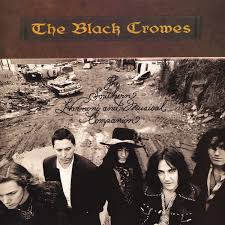 I write “of all bands” because, despite the fact that I am generationally positioned (more on this later) to have embraced their music when it was fresh, I had long responded to what I heard widely played with tepid assent but also with a shrug—with the exception of “Remedy,” a song which for mysterious reasons has always strongly gripped me since the first moment I heard it on the radio some quarter–of–a–century ago. Overall, the Crowes were ordinary radio tunes for me—I would always leave the station playing when they came on, and if I felt like grooving I might even turn it up, but I could never imagine purchasing a record or engaging in intentional listening. It sounded like southern rock party music—for me, not much point.
And southern rock party music it is—gloriously so, good to the last drop. I’ve found ways to weave my own self discovery, over the past decade or so, into flights with the Crowes—through the acoustic retrospective album that Jnan brought into my life, then the Chris Robinson Brotherhood show in SLO for which he is similarly responsible, and lately through my first round of intentional listening. Why self discovery? Three closely intertwined reasons:
— First, I have been reflecting this past decade, in a range of contexts, on my quirky heritage within what I have coined the “redneck hippie” culture. Such redneck hippies, a fast–dying microculture, were the dominant members of my life and family and community in pre–adolescence, and though many elements of this culture (its intense, even fervent, white supremacy; its heteronormativity; its fitful and complex and ultimately unsuccessful writhing with the beast of patriarchy) are those I have long been striving to grow beyond and challenge, in other respects it has made me who I am in some ways I embrace as positive and distinctive: deeply skeptical of, even hostile toward, hierarchy and etiquette and authority, and instinctively trusting of people who speak loudly and passionately and directly. Chris Robinson, if he is anything, is the Living Avatar of the Redneck Hippie.
— Second, attending the CRB show made me feel more at home than I have ever felt in a public space surrounded by strangers. The sorts of ad hoc community that are so valorized among passionate music fans, among baseball fans, the sorts of ad hoc community in which I ought to have been immersed my entire life given my choices of entertainment and leisure time activities, they’ve only ever rooted themselves in partial, self–conscious, incomplete ways for me. I have never quite felt “all the way inside.” I consider this a legacy of my divided childhood, again: too poor not to be ashamed amid my magnet school classmates, too nerdy not to be ashamed amid my metalhead party friends, and on and on and on. But at that CRB show, the people I actually knew in attendance with me (sorry, dear friends), through CPSLO academic connections, were the ones from whom I actually felt most removed: all the strangers were my age, had my crooked teeth, had clothes that cost what my clothes cost, had dance moves that looked like my dance moves. They were redneck hippies born close to when Chris and I were born, almost every last one of them, and it felt like most of them were here in this arena because they were trying to grow beyond white supremacist patriarchal heteronormativity too, and it just felt so damn good to be with them.
— Third, that CRB show was also an integral part of my exploration of a lifelong curiosity that has long been powerfully rooted in my reaching achingly, desperately toward, since I was a teenager, in my reading and my listening and my politics, the 60s counterculture and its consciousness: hallucinogens. It’s risky both professionally and personally for me to write about this in a public blog—professionally, because I teach young people and cannot play an extensive enough role in their lives to ethically ensure that my example does not encourage them, absent safe contexts and important mentoring, to engage in self–abusive and potentially dangerous practices; personally, because my reciprocal love and soulmate detests such experimentation, and nothing makes me more frightened than when she and I feel cut off from one another’s personhood. But I am choosing to write about this here because I don’t think it’s ethical to be dishonest through omission, and because I think these experiences (always at concerts, so far) have enabled growth for me in both my musical–communal being with others and in my ability to get out from under some immensely heavy ideological–psychological burdens. I hear and feel music differently in these situations, and from that, I grow.
I believe very strongly, with my writing hero Robin Wood, that much of our socialization involves elements associated with death instincts and dehumanization: power, domination, greed, protection from empathetic responses to others. I believe with him and with Freire that becoming more fully human involves challenging these calcified habits of thought and feeling and action so that we can embrace creativity and collaboration and passion and openness. I hope that I will continue to develop in these life–affirming ways, whether or not that process involves hallucinogens; I am certain that one way or another it will continue to involve music (as long as my right ear stays healthy for me).
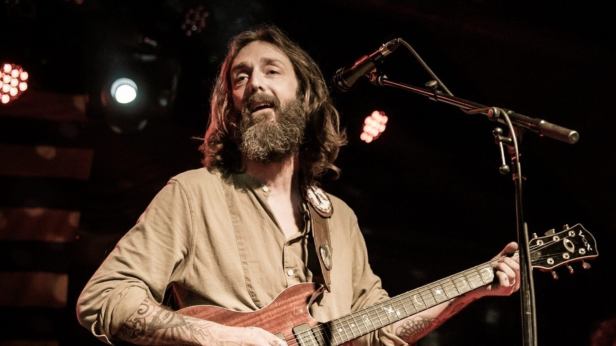
This, in the end, is why I reject the superficial similarity to the Rolling Stones with which the Black Crowes were assailed as “mere imitators” when they were young artists. For me, as snappy as the music is, the Rolling Stones—beyond just the appalling social values of their lyrics, woven into the sound itself, perhaps a credit to them as artists that they weave their value system into their music, but still those values—the Rolling Stones are all Death instinct, all the time. The music of The Black Crowes, even when the music laments broken relationships and addiction and personal failure, is always, without exception, music of the Life instinct. As I wrote this I listened to Mozart, the most overwhelmingly life–affirming musical voice I have ever heard. Though it’s obviously on a different scale, it’s a particular narrow scale, the redneck hippy scale, that matters very much to me, and Chris Robinson, the Avatar of the Redneck Hippie, embodies the Life instinct.
 Selling Dust