
I
As I write this entry, I sit inside my house as I do nearly every hour of nearly every day under the COVID-19 pandemic that’s lately lengthened and sealed up still more tightly by unbreathable air amid wildfires. I hide from an unknown monster; I can’t see the thing I hide from, but when I have to leave my house I wrap my face to protect myself and others from it. The calm assurance I have felt for most of my adult life, as an economically privileged and healthy person, in science and technology as ultimately authoritative and triumphant fields of human beneficence, has been ripped away from me and so many others in my communities. I wrap up, I hide, and I try my best to have faith.
***Note: This entry will spoil for readers the film A Quiet Place as well as the entire Final Destination film series. This series cannot exactly be spoiled, as even horror-film-avoiders who merely see theatrical trailers know that the Final Destination movies are each about creeping death erupting in a bewildering variety of gruesome ways, but A Quiet Place is well worth an unspoiled watch.***
II
Perhaps the single most bloodcurdling sequence in A Quiet Place begins when the pregnant Evelyn, just after her water breaks, steps on the nail that we, the audience, know protrudes from the basement stairs. Web curmudgeons have picked this nit repeatedly, wondering why, even though hammering it down won’t work in the acoustic terrorscape of the film, some quieter strategy like clawing it out wouldn’t have been a prudent step as the family worked to soundproof their home cocoon. Yet to my mind, forgetting or never observing the errant nail is exactly consonant with my experience of human foolishness: Focusing with all our mental might on the things that glide through our deeply entrenched perceptual screens, we are as blind as this film’s aliens to many things directly in our reach. Indeed, like creatures slavering berserkly with hunger, we are least likely to recognize what’s right in front of us when we feel the most urgency to know—thus, the nail is not a “goof” in the film but, instead, a metaphor that pierces viewers with the shock of everyday peril that we routinely look past. Everyday peril is what unites A Quiet Place with the Final Destination series, as both explore the ways that our ubiquitous cocoons of technological cushioning return, when we repress our innate fear responses, into sharp and edgy focus.
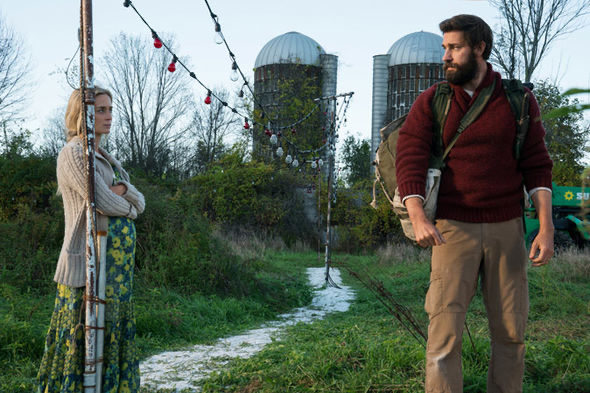
The nail piercing Evelyn’s stair–tromping foot in A Quiet Place also functions as the quintessential Hitchcockian suspense trope, the equivalent to the bomb ticking under the table that Hitchcock insists a director must show us—so that we as viewers experience razor’s edge anticipation that contrasts so productively with the naïveté of the clueless characters seated at that bomb–covering table. In this sense, the nail being an obtrusive, clumsy (diegetically and artistically) element of Evelyn’s grueling labor fits the texture of the film, which raises questions about sound’s ubiquitous presence in human life, and about sound’s relationship to expression. Evelyn suppresses through mortal terror her urgent need to scream as pain is piled upon pain; how many of us could imagine having that strength? Could we, especially, endure it in silence? For her deaf daughter, though, sound is sometimes something to free herself from, something to resist hailing as “inevitable,” as a key barrier needing to be overcome (through a hearing aid)—while at other times, as for everyone in the film, sound is the source of her greatest weakness.
We take sound and the constant textures of sound in which we’re immersed so much for granted, those of us who can hear, both in our everyday living and in our filmgoing. A Quiet Place uses cinema to explore this, keeping us sonically off balance, confused, on edge. We are cut off from all but the most tiny diegetic sounds in most of the film, and even the score is used judiciously, so that the three screams that matter so much in the narrative (from the elderly stranger, from Evelyn, and from the father) each sound appropriately earth–shattering to us in the audience. Moreover, we are urged by the film to notice so much silence, urged to listen intently for the full 90 minutes by the peculiar lack of sound combining with the peculiarity, among monster movies, of light and motion being no worry for the humans who are prey. This is a delicious cinematic horror experience, especially on a first viewing, and it’s the way the film answers the question of why it must be a film rather than a short story or a play or an audio script: Through the film, we are immersed in the same strange audiovisual sense–scape as the characters; through viewing it, we experience their estrangement from/within the everyday. And as I write this, I, too, feel estranged from/within the everyday, every day.
A Quiet Place helps us feel the ceaseless struggle it takes just to stay alive in a world preyed on by its swift, sightless snarlers. Its characters display exhausting vigilance, striving to stay silent while they sweat through scavenging, sheltering, improvising for food and technology; even their efforts to relax are, genuinely, great efforts. In this film, mere living is never easy and nothing can be forgotten.
III
“Death is around us, all the time”: William Bludworth, Final Destination
We open with a credit sequence replete with frosty, ominous chords and a slow montage of objects that are not significant in the film but that are, instead, archetypes of the ensuing film’s themes and tenor, an omniopticon of ominous objects—a toy monkey, an oscillating fan, a pair of scissors. This credit sequence, a fluidly unanchored and geometrically elaborate chain of images, fits snugly within its time frame in Hollywood visual culture, following (in 2000) closely on the heels of influential similar credit sequences in thrillers by Fincher (Se7en, Fight Club) and sibling combos the Wachowskis (The Matrix) and the Hugheses (Dead Presidents, and a year later in 2001’s From Hell), among others of the era. But uniquely here, in Final Destination, these opening credits form for us a vital pathway to the glorious beating heart of this film, of this franchise throughout all of its five incarnations, a beating heart nearly crushed by the pressure of the horror film clichés that encase it—but, in the end (and in the Final Destination universe it’s ALL about how we conceptualize the end, not about the grisly end itself but about how our anticipation of the end lives within us, how it enlivens us), I’m sanguine that the film’s heart beats on, surviving through the thematic vim of this brilliant conception.
Here’s the conception about which I gush, encapsulated quickly: One existential responsibility thrust upon us by the human life into which we are thrown, without our will, is the need to embrace our fragile and jittery survival instincts, the part of us that tends toward Eros, toward the longing to live, and away from Thanatos, the drive to die. Yet in the yearning for more life, these films warn us, Eros has hailed Thanatos too often, and now Thanatos dominates Eros: We have cocooned ourselves softly and smoothly in cool technological structures that have deadened our survival instincts. Having long repressed those very instincts, we have, Final Destination contends, forgotten them.
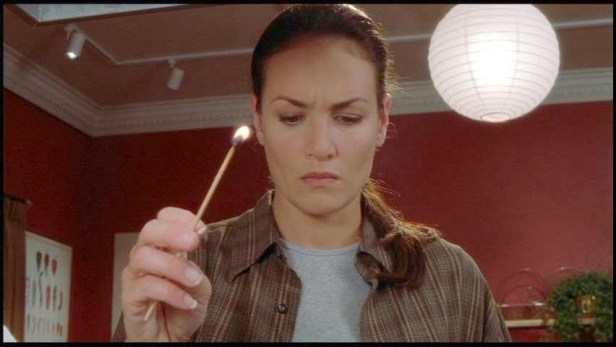
But as Sigmund warned us, that which we repress returns to haunt us. Perhaps the most memorable death sequence in the entire five–film series, and certainly my favorite, epitomizes the logic of all the films’ sequences. This sequence also shows why the FD series must be cinema rather than some other art form, just as A Quiet Place did—because like the characters in the FD series, we must face our fears by being shown that which we have learned to overlook. In the first film, the teacher, Ms. Luton, makes herself tea as she packs to move (she hopes, away from the horror of the recent shock of the airplane explosion that killed dozens of her students). Her aesthetic keepsakes, and indeed the design features of her current home, are rife with the knife—a dagger over her door, a curved sharp edge she protects in bubble wrap. But despite her obsession with care and her increasing feeling of mortal terror, she forgets simple physics, pouring frozen vodka into a mug she’s just emptied of hot water even as she reminds herself aloud, to calm her nerves, “It’s just a mug.” The mug’s ensuing and unseen crack leads to liquid leaking into that ultimate exemplar of our personal technological cocoons, a computer monitor, and precipitates an outlandish, preposterous, and darkly humorous spasm of blazing fire and icy steel as a bewildering range of household objects intertwine in order (pun intended) to claim her life. The very cocoon of safety in which we have enshrouded ourselves, refined objects meant to give us comfort and succor, meant to allow us to stop fighting so vigorously and constantly for more life, this cocoon can become—in the hauntings staged in Final Destination—that which will snuff us out. Uncanny indeed.
The fearful moments in these films goosebump us by reminding us not of blind aliens or other scary monsters but of the supercreeps we feel while here in our authentic, everyday world—shadows crossing a room, wind gusting cold, headlights suddenly behind us on a country road. This is what the credit sequence in the first film prepared us for. These are the “signs” that Bludworth the mortician repeatedly insists we must learn to “read.” But he also warns repeatedly that we cannot “cheat” death, and that’s a clue to the thrilling philosophical position that’s set me to writing this piece. For the caution that we cannot cheat death brings to mind the best characterization of Death ever, better by far than this faceless force in the FD fantasies, better even than Bergman, which is Neil Gaiman’s Death of the Endless. She told the young boy with the soccer ball that he shouldn’t feel cheated because he got what everyone gets, which is one lifetime. And that points us to the the true existential crisis that the FD series masks with a bunch of paper-thin characters who come to life barely more fully than Gaiman’s one-page soccer kid. The existential responsibility embedded in the FD series is not that we must confront our inevitable, particular, precise death, but instead that we must remember the omnipresence of undifferentiated death, that we must face directly the very real and persistent threats, the entropy that we have, to our disservice, endeavored to escape through our technological cocoons.
We have, as a species, the hubris that Clear and Alex show in FD1 (definitely the best of the series, even though I goofily love them all). Alex and Clear constantly attempt to know, to understand the puzzle. In each of the five films, characters search for meaning…speaking of “death’s design,” trying to recreate the sequence of events in which characters were meant to die before being saved by visions, looking through photos from a carnival, listening with us to John Denver songs. Their thirst is the same one that has spurred our efforts to tame the unruly natural world and led us to create our cocoons of technology. But we cannot “know” because our human lives are at their core mortal, filled with mystery, and technology cannot save us from the mortality nor from the mystery.
In the end (heh heh), though I consume these films over and over as if they are cinematic pink grapefruit candy, they lack the nourishment of true enlightenment because they grasp for the horror film trope of the unseen, unheard menace: They anthropomorphize death, attempting to have it both ways by mocking their characters’ vain quest for meaning–making yet also showing us repeatedly the nasty, bitter, yes mocking, viciousness of “death’s design.” This is a filmmakers’ misunderstanding, I contend, of the films’ actual insight, parallel to Robin Wood (rest in peace, my textual love) showing how the authoritarian Hitchcock could not fully control with his misogyny and homophobia the much more complex and rich material emerging from his very own cinema. For Death, even when capitalized by artists’ renderings, has no design for us because death, like the technologies we create to cheat it, is indifferent by definition to human ingenuity. Death is a force worthy of our terror and dangerous to repress/forget precisely because it is not self–aware, nor self–animating, nor engaged in a quest for meaning, nor as hot as fire nor as cold as steel. Death simply and flatly is—unremarkable, uninspiring, undifferentiated, and like life itself, as dull and undying as the everyday. And I am trying, every day as we shelter, to enliven the everyday, to cheat death by loving life.
 Selling Dust