
Last night, Game Four of the World Series unfolded as an all–time classic. The Rays, a significant underdog from a place (my home region) that struggles to support its small–market, working–carefully–at–the–talent–margins team, a team that has never won it all, thrillingly managed to forestall a daunting 3 games to 1 deficit by turning a defeat into a victory with one swing with two outs, and two strikes, in the bottom of the ninth. The game was a back–and–forth affair all night, with the favored and wealthy and talent–rich Dodgers, aching for their first title in 32 years after nearly a decade of near–misses, scoring all seven of their runs with two outs in the inning yet still coming up short.
These elements, alone, are enough to merit the “all–time classic” designation. However, the way the final play unfolded is what matters most to me as a passionate, obsessive fan of the game, its professional history, and its dynamics for more than four decades.
One element sports fans often esteem, in any game labeled a classic, is a very high quality of play. Writers laud contests decided not by gaffes and flubs and controversial outcomes but, instead, by precisely placed and unhittable pitches, by leaping and athletically stunning catches, by towering, arcing drives propelled from the meat of the barrel. Not last night, though. That’s not at all how it ended. Last night, a marginal player named Brett Phillips, last–added to the roster, not especially young or promising, looped a 130–foot single just past the infield, and his team then benefitted from two separate physical errors that led to the winning run. Gaffes and flubs if ever there were such. And I insist it was the best possible state of affairs.
All major–league players, even Brett Phillips and even given my minimizing description of him above, are drilled in the basic skills of catching and throwing a baseball from an extremely young age—often started as mere toddlers in games of catch by parents with statistically ludicrous dreams in their hearts. Beginning with the time they are school–aged, they have spent, by when they are Brett Phillips’ age (26), tens of thousands of hours throwing and catching baseballs. By my calculations, Brett Phillips has quite probably spent at least as many hours throwing and catching a baseball as I have spent reading—and I am a 50–year–old, fully promoted university professor with a 30–page CV. So has every single one of the 1200 or so players who saw major–league action this year, and every single one of the 10,000 or so players who will play professional baseball whenever the minor leagues start again.
One consequence of this is they begin to feel like robots. One of my three or four favorite players of all time, Chipper Jones, is the ultimate baseball robot: If you observed the game as a Martian anthropologist and set out to reconstruct the optimal baseball player down to every ligament, every flicker of the spin–on–the–pitch–scanning iris, you would build Chipper Jones. I used to hate him for this, until I’d been watching him on tv several days a week for half a decade and realized, around the time I started to teach college, that I actually loved him. They all begin to feel like robots. They are all, now, multimillionaires; Brett Phillips, among the most marginal players in the major leagues, earned more than half a million dollars this year. They all know one another; they train not with their own teams in the offseason but with whichever other multimillionaires happen to be their closest friends in this exclusive club of rigorously, ruthlessly competitively selected cream–of–the–baseball–robots. It begins to feel arbitrary, unimportant, even to a fan like me, the deciding of who wins and who loses based on the razor–thin margins of difference in the actions of multimillionaire baseball robots competing against one another for the World Series title and then, a few weeks later, all jovially yachting together somewhere in the Southern Hemisphere where it’s warm and tax–sheltered.
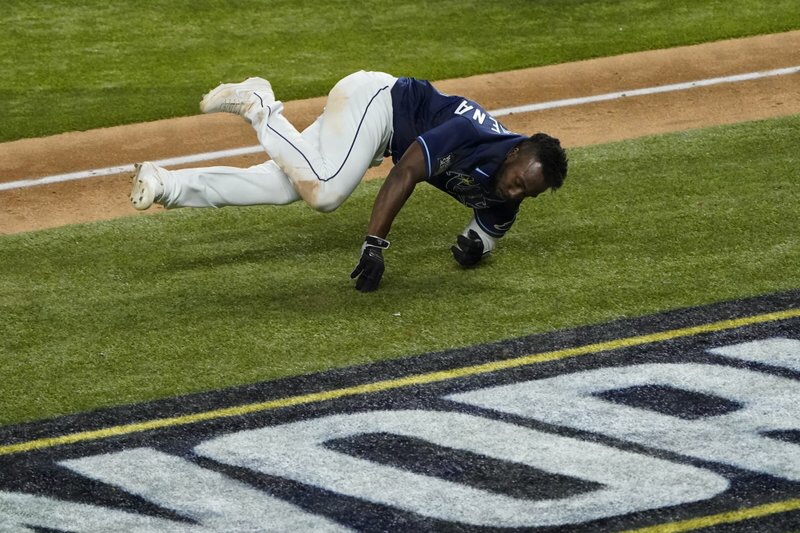
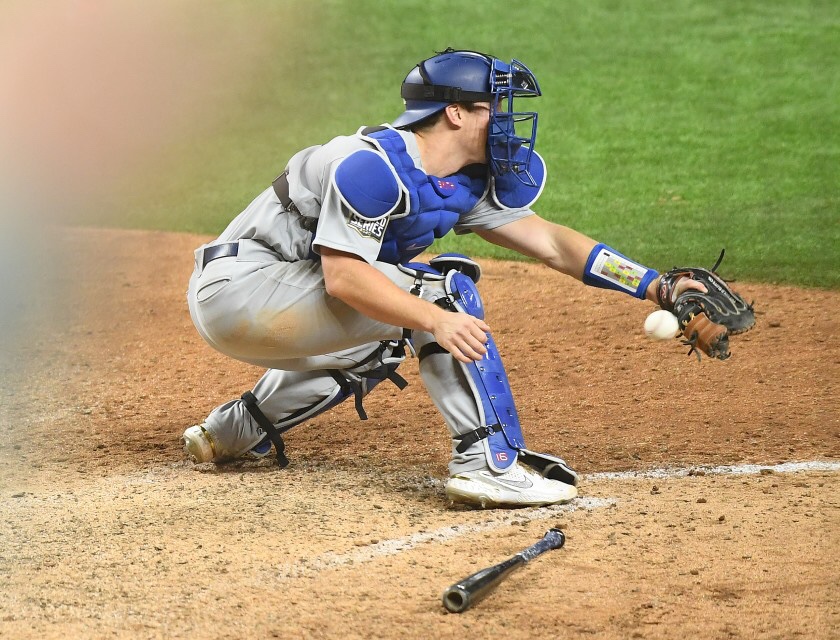
But not today. Today, Chris Taylor does not feel like a robot. Will Smith does not feel like a robot. Randy Arozarena, one of the greatest single–postseason hitters in the 116–year history of World Series playoff competition and a guy who was dumped in January in a barely–reported afterthought of a trade, does not feel like a robot. These fellows, before my eyes in real time, felt the moment, felt the history, felt the pressure. The moment caught them, and Chris couldn’t catch the ball in right, and Will couldn’t find the same ball on the relay home even with his giant mitt and Randy couldn’t even run straight and fell down and went the other way and then back again and lunged, prone, again and lunged and crawled and laid there, smacking the plate over and over and over with his “it’s soon going to be worth tens of millions, for heaven’s sake stop that!!!!” batting hand.
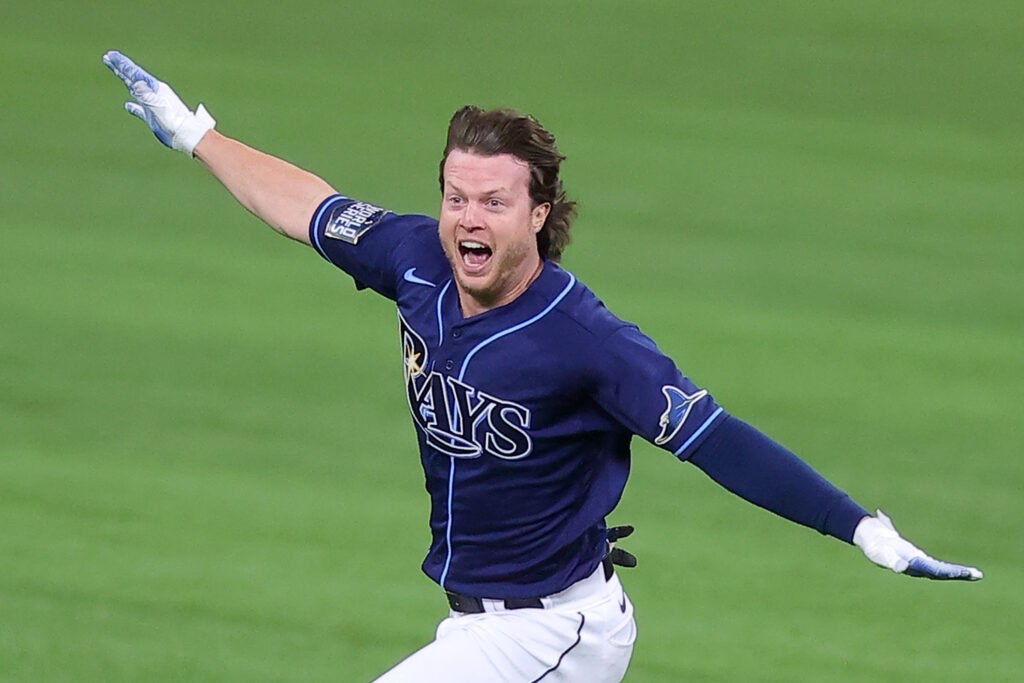
And this season, of all seasons, already cheapened by multimillionaire, perfectly–drilled–for–decades robots choosing to play a game for my entertainment while most people can barely leave the house for fear of helping others die, cheapened by reduction to 60 games and a weirdo “tournament” playoff in neutral sites mostly without fans, cheapened by the talent–richest team in baseball adding one of the game’s best players just in case they might need him, this season it feels great. This morning, it feels great to remember the image of a local kid (Seminole High!) making good on his return to his hometown franchise (Brett was four years old when the Rays began their first season; for him, there has always been major league baseball in Tampa; wow, that’s a lifetime of difference for me) helicoptering around the outfield. When Brett was four, the odds that he would ever play even one inning in the major leagues were one in a million. Last night, a mere nine hours ago, the chance that any little kid a hundred years from now would ever even come across the name Brett Phillips in an online encyclopedia as she read about the legendary exploits of Mookie Betts and Kenley Jansen was equally minuscule. But now, Brett Phillips will be remembered, no matter how it turns out. For now, the Rays are still fighting, no matter how it turns out.
We really, really needed this game, and this finish, right now in the game’s history. For now, they are not robots.
 Selling Dust
Perfection of the imperfection. Loved this!