
Structures start bare, but scaffold broader strokes. Mighty strokes, making something extraordinary where once we were separated, in the most ordinary way, from ourselves.
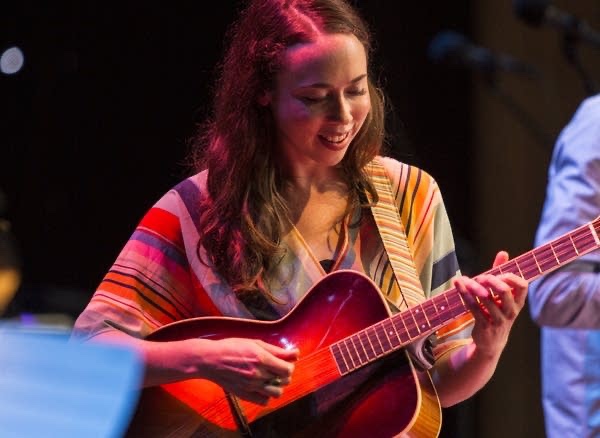
Sarah Jarosz and I are no longer separated. An extraordinary claim—surely, it was some social media intern who liked my post, not Her Musical Majesty making meaning of my praise on what is, of course, a rather public page. Surely, she’s merely another in a long line of examples of one of my most ordinary pathologies, pining for parasocial interaction. I’m belated, learning to love her a mere year ahead of the pandemic and so never even having heard her play live. Instead I grasp at swag like the gorgeous black hoodie she (surely her marketing team!) sent us with a signed copy of the new album, and I scrabble for sense in the art, in my experience of the art, in my ordinary paralogical manner.
You’re too familiar with this pattern. For more than a quarter century I’ve pulled at you, craving all forms of connection, aching to understand how you music. Music as a verb is another grasp, a connection to sound studies scholarship, another borrowing from found materials to make an aesthetic nest in which I can seed my own growth. But some scavenging reveals sources far too stubborn for comfort: Your cousin, wanting to be watched but unwilling to teach me; your father, still singing even in a pandemic but silently listening and waiting when I demand discourse instead of disciplining myself; and even you, my closest friend, choosing to music differently than my questing metaphysical bent, my search to know through constant communion. You remain, as a fellow listener, grounded in a lifetime of embodied learning. Patient practice. Calm.
Play it sweet and low…we’ve got nowhere to go…I am yours and you’re the love I know
[Ring them bells, ye heathen…from the city that dreams]
I think I know what I want you to teach me: how you music. How it feels when the sounds course through you. How you listen. But what we’re both learning together lately is that we grow most when we’re surprised by what we have to teach one another. I love your unfolding queer being in broader strokes, mightier strokes, much more vibrant strokes than I could have ever envisioned. Our structure started bare, and we loved it and entwined ourselves in it but forgot that the structure is not the love. What grows is the love, love that looks less like the scaffold the longer we let go.
You’ve encouraged so many artistic explorations for me, just not the ones I imagined I wanted. When we came together, we each planted a musical seed that sprouted for one another—Indigo Girls from you to me, Suzanne Vega from me to you. But for decades as I pursue passion after musical passion that I scream toward you, you whisper “women. Why not more women?” And far, far too slowly, at a Harris–on–the–big–ticket pace, I listen more closely. This blog ballyhoos P!nk and celebrates Cecilia Bartoli and Courtney Barnett, but remains dully deadened by the weight of male musicians. What’s especially uneasy for me are the gendered vectors of my lifelong voyage of musical understanding. I want so very much to learn to think musically, to hear how melody implies harmony, how harmonies create tension and release, how polyrhythms push the pulse into heart–racing new dimensions—not just conceptualize these processes but feel them, truly know them. Surely, your cousin and your father and you would all caution that lack of disciplined practice will always leave me some distance from this shore. But in striving to sail as far as I can on the breath of song, so far I have served mostly male aesthetic captains. And the eddies where I’ve found the most powerful swirls of enlightenment, the ones that have borne me closest to the beacon of musical knowledge, have been the most male–dominated of all—wayfinding through the codes of classical compositions, held aloft on the complex textures of acoustic combo jazz, diving deep to find the pop pearls of the Beatles, circled by the circus sands of Dylan.
I wrote every line for you…I made time when time was all but gone
[Ring them bells from the sanctuaries…’cross the valleys and streams]
Why not more women indeed. As you know better than anyone, I’ve spent a lifetime peering into the past, tracing influences like those I cite above, influences that helped form the music I inherited from my mother and was encouraged toward by my older brother. Yet Sarah Jarosz is the first artist, among all of those who have radically rerouted my sounding tides, who is actually young enough to be our child (you’d have had to be even younger than my father was, but the point holds). And in the paralogical doxology of my worship of art, she has built me up, cultivated fresh and powerful flourishing in my listening life.
I wonder if her own belatedness in my musical chronology—this performer packaged as contemporary folk/bluegrass who evidently grew up listening to Dylan and Beatles and Joni, of course, but also to Waits and Prince and Radiohead and who alchemically joins these in her work—is the trick to this parting of the seas of my musical muddle, this parting that’s leading me to new insights. In her work, I can hear at my best how musical elements infuse one another, how the voice works with the instruments and with the song structure; in her work, I can hear at my best how arrangements and textures serve the sound. Perhaps other artists, older artists or artists I grew up listening to or artists who grew up along with me, create sounds in which we’re all closely immersed, so that no matter how sophisticated my study of them I’m in too deep—and someone Sarah’s age can, instead, change the flow because she steps differently into the river of time (more borrowing for my aesthetic nest, thanks to Elyse!). Or perhaps it’s the style: The bluegrass structure is bare, leaning on the leanest of textures in most cases, acoustic instruments and small combos carrying the sonic weight—so that even when Sarah scaffolds from this foundation to build more pop–oriented, lush tracks, the layers are crystalline and their interrelation gleams for me.
More than anything, though, even in the country–picking tunes she spins that drift further from my aesthetic instincts on the back sides of albums, even as a spare solo voice in a YouTube concert with masked–up camera operators in which her between–song banter reveals her awkwardness, her dopey shyness, and yes, her ordinariness, I hear her extraordinary musical strength. It comes not from packaging nor from massive wall–of–sound production nor from electrical thrumming nor from an overwhelming bellow of a voice. Her extraordinary musical strength comes from her mind, and that’s likely why every tiny phrasing choice she makes is apt to my ears. That’s likely why I learn so much from listening to her work, why when she creates music I pay it so much mind. No longer separated; if still separated from Sarah or from you, at least no longer separated from myself.
Build me up from bones…wrap me up in skin…hold me close enough to breathe me in
[For they’re deep and they’re wide…and the world’s on its side…and time is running backwards…and so is the bride]
There are too many poems I meant to form for you. Too many songs I wanted to sing with you. I have twisted myself into something different than I meant to be, plumbing depth after musical depth looking for…what? What I am finding in these troughs, these ridges, as another Sara[h] would suggest (Ahmed), as you have helped me to see, is more of who I am. I intend to continue my voyage. I look forward to what I will hear and who I will become. I hope to keep finding you even as I find myself. But I remain forever glad that I know you in my bones.
 Selling Dust