
T.o S.ongbirds
To Robin: I didn’t know what I didn’t know. For my first forty-nine years alive, I looked past birds, getting to know only the kinds that obtruded, that insisted on their place in my narrow cone of perception—puffing pigeons pecking pieces, screaming seagulls scrambling shellbits, blackening buzzards beckoning bells, cackling crows courting conflict, and over the past decade and a half at my green-campused school, gaggling geese grunting goonishly along the grass. Other birds were merely “little ones” or maybe “colorful ones,” an undifferentiated melange. But these past thirty months, my metamour the ornithologist has remade my mindset. And the world is slowly becoming a beating, babbling, profligate aviary.
I didn’t know what I didn’t know. Who’s the “I” who could know what’s not yet known? Recognizing this quandary, I recognize how we make ourselves, how we evolve our complex and beautiful “I,” not with divine intelligence directing a teleological trek but with a mildly intuitive, mostly befuddled clutching toward pieces and shells and carcasses and countermelodies and fellows in our flock. We build our homely nests as we go, and we feed ourselves from the grooved impulses that fuel our feeling forward into the future.
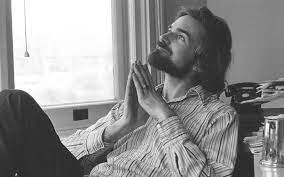
You, Robin, the essayist whose artistic goals I most strive to emulate, help show me how art catches fire to fuel feeling. You insist that we critics must shed light on that reaction, that we have to hope we can help catalyze it for audiences—otherwise, why write? You describe two aspects of this so beautifully in Personal Views: One, how art cannot by itself guarantee that we grow toward empathy and care and mutual responsibility, but, you said, art’s part of that growth; art is vital nourishment for it. Two, how your own audience practices involved deep dives, enduring commitment to an artist or even a single artwork over an intense initial span of engagement until, you said, the passion shifted not because the artist or the art were in your past but because you had taken them inside you; the art had become a part of you.
I relate to your audience practice so very strongly, always but especially now, as I have been passionately spending the last 20 weeks taking Taylor Swift’s art inside me. I relate to so much of your writing so very strongly; I have taken your essays inside me, and you sing in my mind every time I write in this space. And now, so does she. For just one example: One of the most extraordinary qualities of her lyrics is their stunning quotidian aptness, refusing the arcane, oblique postures of “poetry” to favor something much more constant and thereby differently resonant; many times each week, with no exaggeration, moments in ordinary interaction chime with a lovely or clever turn of phrase in a Swift song and I hear myself hearing her, turning everyday talk into threads linked to lyrics. Two songbirds living now inside me, a robin (a name you, born Robert Wood, chose for yourself) and a swift (a name into which she was born, an extraordinary invisible string that it’s just so pretty to think tied that newborn to the artist who darts like lightning from one of her chosen fiery aesthetic chimneys to another while a frenzy of literal millions follow her without fail). Yet I hear one song you sang repeatedly in your work that’s discordant for me now. It always clashed a bit, your callous dismissal of popular music (one of your sentences, among others, sticks in my mind well enough to not have to look it up: “Not all rock music is worthless, necessarily”). Especially now, though, just as you took time more than once to underscore the irony that Leavis, your towering role model for all art criticism, including your stock-in-trade, film criticism, had no regard for popular art generally and would likely have seen no value in film criticism in particular, I need to underscore the irony that even though I am very confident you would see no value at all in the work of Taylor Swift, you are the person who teaches me more than anyone else how to describe why her work has so much value for me.
You, dear Robin, taught me how to hear the Song of Swift through your entire body of critical work. That work models (in your criticism of specific artworks) and enacts (in your evolving voice over your career) the great and terrible task of creating ourselves through our engagement with pieces of art, our engagement with bits of interactions with those who shape us. This is my favorite aspect of Swift’s art, its unwavering commitment to staging—staging as in making public for witness, staging as in crafting for performance, staging as in moving through constellations of temporal coherence—her growth toward herself. She stages that growth through her art and through her relation to others. She asks, at the start of the song that (irony again) more than any other makes me worry that she’d see no value in my valorizing her, “the lakes”: “Is it romantic how all my elegies eulogize me?” She frames “I Knew You Were Trouble” and “Out of the Woods” in their videos with meta-text celebrating her journey to find herself. But these overt textual acknowledgements are mere surface; like all the best art, Swift’s growth toward herself has much richer pleasures to offer in the subtextual clues, the subterranean shadows, the sublime fusion of form and content that I mean to trace in this entry—my eulogy to my passionate stage of living and blogging for months through Swift’s art that is also my elegy to its new life inside me.
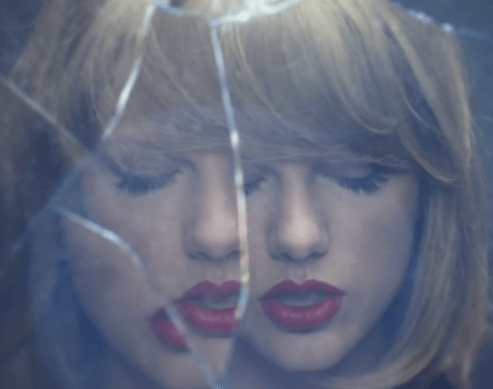
The first song on the first album points the way, maps her magical soundscape from the outset with shimmering touchstones. This song pointed her own way forward even then, when she didn’t know what she didn’t know. “Tim McGraw” imagines the end of a yet-to-end romantic relationship, imagines its contours of growth and decay over time, imagines how that relationship even when it dies might stay rooted in its participants’ evolving senses of self and other through ready-to-mind symbols in the culture, imagines how the most profound of those symbols might be a famous artist to whom she had imagined a relationship as a crushing young girl determining one day to emulate him, imagines how she might achieve success like that artist has achieved and thereby grow beyond the confines of being defined by the yet-to-end romantic relationship. That’s a whopping lot of densely packed layers of imagined touchstones for the first song on the first album of a teenaged songwriter still in high school, an invigorating embrace of the life instinct to possibilize purposefully, especially in a popular music world packed with elderly, hollow men on rock tours making millions for babbling incoherently about the drugs and sex they once tried to kill themselves with decades ago. Sure, the tropes of crushing girl and favorite song and little black dress are worn thinner than the knees of the most blatantly hipster-rustic-chic jeans—but that’s the very point, the very limits of imagination that she courts in hopes of overcoming them. And lest we confuse the imaginings of a future of indelible ingenuity dared by a fame-dreaming teen in “Tim McGraw” and “Teardrops on My Guitar” and “Our Song” with hubris—even her wildest dreams then could not have featured a reach for a star the size of her star today. If when you touch the sun it doesn’t burn but instead lights you up, you are no mere Icarus.
Another way I am astonished, dear Robin: The jeweled touchstones that trace the fabulous filament of this invisible string tying her to her, they shimmer forever and always in her art. I’ve mentioned before in this space how I have a quirky love for songs at the dawn of an artist’s career that imagine success yet-to-exist and, thereby, help bring it into being. In “Dancing Nancies,” one of my favorite such tracks, the subject is alternate life paths; Dave Matthews wonders if he might have been a parking lot attendant, or a trans person, or lost altogether, or a performing artist—and once he becomes the latter, all of the former are presumed foreclosed, even gender identity, within the logic of the song. Dave’s multiverses never seem to touch one another. Taylor, though, doesn’t simply reflect in one singular early moment the high aspirations of a hopeful kid skipping her touchstones from a homely shore—her songs never go dark to the penumbra of overlapping multiverses, never stop arcing doubly toward her center and toward an outward-racing stratosphere, creating these in new tension each time. A playlist constrained to two numbers per album, say, might include “Tim McGraw” and “Teardrops on My Guitar” and “Fifteen” and “Change” and “Mean” and “Long Live” and “The Lucky One” and “Starlight” and “Welcome to New York” and “I Know Places” and “End Game” and “New Year’s Day” and “Miss Americana & The Heartbreak Prince” and “Cornelia Street” and “the last great american dynasty” and “mirrorball” and “‘Tis the Damn Season” and “Dorothea.” This playlist would feature deep, rhyming, complex resonances juxtaposing multiple songs and characters and themes across the series while still, despite this career-spanning scope, developing a cohesive and active, Tolkienesque narrative of a young woman moving toward earthshaking cultural power that ceaselessly threatens her identity even while (re)fabricating that fluid identity, a narrative of boldly going again and again where no woman has gone before and, in so going, getting to be who she always imagined she might be when she didn’t know what she didn’t know. And when I take the whole body of work inside me, I can hear that it’s not just this cherry-picked playlist; the arcing double rainbow I try to trace here, it everywhere illuminates her art.
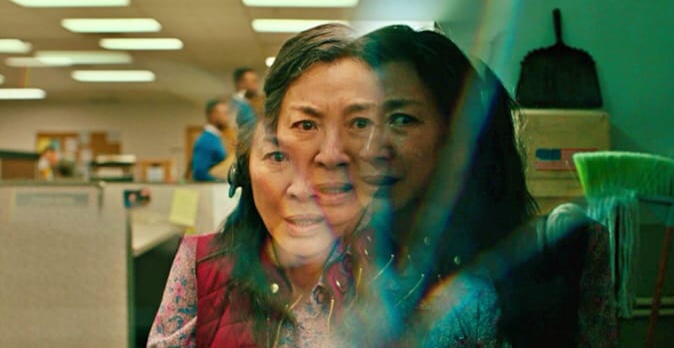
I might, in many of my own possible lifetimes, never have been able to spot this breathtaking double rainbow; Dave’s right about that. Knowing this makes me delight that much more in being, in this life, a middle-aged metalhead man who Swizzles—because her art, in particular, imagines and illuminates all the forms of a “me” that moves through and toward certain forms of music, certain sounds, hers and others. Her possibilizing is relational, imaging in her art how she’s shaped by Tim and Tanya and Shania and Juliet and Joni and so many others and thereby uniquely legible, to herself and to us, as Taylor—whether “Taylor” the idea or Taylor the real person, the effect is powerful either way. You, dear Robin, show how generative popular film genres can be, artists and audiences sharing a history of productive constraints, a gallery of symbols and structures through which ideas flow in creative channels conditioned by convention, productive constraints that thereby carve new designs that remain uniquely legible to us despite their freshness. One very recent example of a film exchanging generic conventions with its audience in a playful and productive way is Everything Everywhere All at Once, which answers in its cartoonish fight scenes and its simultaneous visualization of fractured selves/lives and its coy casting of Jamie Lee Curtis the question of why this story is necessarily one for big-budget cinema. On the same level, it’s the casting of Michelle Yeoh that works best by creating a delicious cinematic trope through which to explore the question of how her character’s capacities might have been hidden or held aloft across a range of possible lifetimes; so an action sci-fi caper centering on a dispirited, middle-aged laundromat-owning immigrant who can see that she is also—not “might have been” but somehow “is also”—a widely beloved martial arts icon, and many other things besides, makes a special kind of sense. You, dear Robin, write about this approach, about the compelling critical potential of careful study of the “star image” of the most visible actors, about the ways their presence from marketing to being onscreen strongly shapes a film text. The best example I know of this principle is Fight Club, in which the novel’s tracing of the hypermasculine, unattainable double fantasy life of Tyler Durden through imagined second-person address has to be somehow translated to the big screen, where what is imagined is always already manifest—and the absolutely perfect way to do this in 1999 is to cast Brad Pitt. Star images in mass mediated culture, gathering into themselves as they do a fuzzy but fragrant haze of established connotations, are a way of telescoping the nostalgia impulse. Nostalgic fantasies, our choosing memories of a past that likely never happened that way and never quite meant what we imagine them to have meant, then constraining our imaginations based on these—well, constraints can stultify, sure, but they can also spur. Nostalgia, as Disney perceived perhaps better than anyone ever, is woven into the foundation of mass mediated popular culture, our shared consciousness across streams of shimmering electrons held together by a feeling for what we might have kinda but not really experienced together. In listening to Lover, perhaps a surprising choice for this insight, I first (ridiculously belatedly) recognized the overwhelming power of nostalgia in Swift’s imagination, a vein of feeling that, I finally can perceive, is a rich resource flowing into her work at every stage, always at the forefront of her style. Images of long-settled places, longed-for natural idylls, long-trodden stone streets, long-loved movie houses (pointing back to you, dear Robin!) abound all over her art. “Tim McGraw” points the way right from the start in this sense, too, not only by crafting a narrative of nostalgic clutching at favorite songs and little black dresses but also by glossing how the star image offered by mass mediated celebrity can be a fund of futurity for glimpsing ones’ capacities as they kaleidoscopically glow across the multiverses.
Popular music genres, I promise you despite your doubts, dear Robin, bring artists and audiences together in this generative way, too. Swift, with her extraordinary ear, engages the most well-established popular idioms with admirable acumen. She teaches me about the precise details of each of the generic forms and norms she takes up, from country to pop to hip hop to alt-folk, but impressively she remains audibly “Taylor Swift, the brightest star” in her work throughout each of these. Popular music is a collaborative art, like your beloved cinema, dear Robin, and Swift collaborates with an impressive range of musicians whose singing/playing/writing/producing support her, but she uniquely inflects each track in high auteur style. My metalhead memories arm me with insight into another one of her musical fingerprints that pairs with her powerful nostalgia: her emotional intensity. Through each musical-idiomatic lattice that softens and sharpens them into distinct patterns at each new stage, the fury and desire and sorrow that she grafts onto her nostalgic memories and her determined imaginings are as muscular as the emotion in the hardest rock. Her emotional directness is a musical fingerprint that makes a special impression on me, connecting to my movement through major classical composers: To Bach and Beethoven and so many others, I listen and I respond, but then I read scholars’ discussions and realize that the emotional contours of the work missed me a bit until I got some help to better grasp them. I embrace this process, love it, because connecting with fellow writers like you, dear Robin, is part of my broader relational approach to sharing art with like-minded others. I’ve read many, many thousands of words on Mozart and Shostakovich, too, my two favorite classical composers, more words than I’ve read on any other composers—but all these enriching words affect my intellect, while my emotions the artist has already precisely targeted without writers’ mediation. My emotional footings with Mozart and Shostakovich are always sure, because these artists ensure it, emotional directness the common gift that made Shostakovich a great film soundtrack composer and that made Mozart’s melodies hummable by innumerable humble Viennese citizens who couldn’t afford to attend his operas. Swift is like Mozart and Shostakovich in these ways, standing out even among the Disneyfied culture of popular music as the surest in her capacity to communicate emotionally, standing out because of both the force of her feeling and the sweeping shades of it shown through her songs. This is one payoff of the quotidian aptness of the obscurity-eschewing lyrics. This may be one link to legions of young women, living in a sexist system that demands that they relationally integrate with others, picking up a guitar to put it their way after hearing her. Like the best auteurs you valorize, dear Robin, like Hitchcock’s fun silent mini-cameos in his films, she ever and ever stokes this core dimension of emotional nuclear fire at the center of the media image “Taylor Swift” with a knowing, simultaneously self-mocking and self-creating wink—it’s a constant stylistic signature she ensures we know, yes, all too well, because even in her most recent, most character-and-narrative-driven, most musically and emotionally mature and nuanced work, still her tears ricochet.
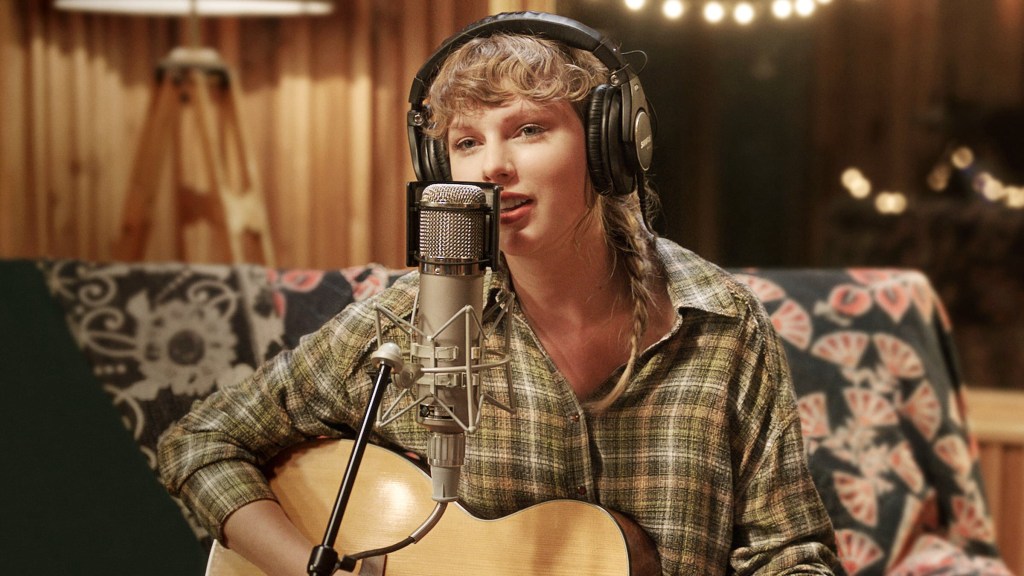
It’s a superb word, “ricochet,” one of those words like “bumble” or “sludge” that enacts in its phonetic movement what it denotes. Swift’s tears on the overwhelmingly beautiful Folklore aren’t an unending waterfall, aren’t an overwhelming deluge—they redound in both senses of the word, they glance off one place and gather steam as they move toward another, and also they accumulate importance, but no, redound won’t do it either because they also endure in time, three consecutive syllables that elongate beyond the two monosyllabic refrain words already uttered, that elongate by moving from the short “i” to the longer but still slightly-curled-up “o” to the final, fully-long “a”…they quite precisely ricochet. Critics, even the ones you would dismiss as lazy music journalists, dear Robin, are increasingly and rightly celebrating her maturing command of her singing voice, evident in her rerecordings of Fearless and Red, but just as evident to my ear is the closely coupled maturing of her command of the language she shares as she sings. One way I hear this is in my favorite Taylor Swift vocal signature, this thing she does that reminds me of a glorious Lin-Manuel Miranda moment early in Hamilton when the personality and concerns of Miranda the human being, a Puerto Rican American man grappling with racism and the creation of national identity through the purportedly light medium of the musical, burst suddenly through the words and tone of character as he says upon meeting Burr, “He looked at me like I was stupid…I’m not stupid.” Swift has these bursts of humanity too, throughout her work, audible even among songs supposedly already centered on herself ubiquitously, when her own special senses of humor and wonder, her own personal curiosity and charm, erupt as she sings certain phrases. A great early example from “Love Story” is the whimsical initial hint of her brash dare to gloss Shakespeare before the famous characters are yet named on “I’m standing there…on a balcony in summer air.” As her command of words grows more precise, these eruptions swell in vitality for me and increase the frequency of the shivers they induce in me as I listen. To choose just my two favorites among the many that enliven her last two albums: In “the last great american dynasty,” a magnificent song sculpting a character who forever seizes the outrageously incommensurate as a way to make her mark, on “she stole his dog and dyed it key lime green” (she only sings the line once, and you can hear perfectly how funny and revelatory she thinks this prank was) and in “mad woman,” another magnificent song linking sexist silencing of voice to witch hunts and to hegemonic cooptation of women’s self-harm, on the refrain (especially on the Long Pond Sessions version) “and you find something to wrap your noose around.” The Long Pond Sessions film clarifies unequivocally that she’s earned this burgeoning command of language the old-fashioned way, true to her nostalgic heart as someone lately invoking Wordsworth—because you know when you watch her talk about ideas in this film that she reads. Constantly. Hungrily. And makes time to do it. Not merely websites or magazines, but books, difficult books, great literature and poetry, and that reading shapes her art, and as someone living in the blinding, numbing, rapid and demanding stream of ultra-celebrity since she was a teen, she is someone I admire for this. Acclaimed literary critic Elaine Scarry, whose insights are often cinematic despite her writing about novels, dear Robin, celebrates the subtle but essential effect an author can achieve by describing evocatively something that is light, thin, translucent, soft, and immediately juxtaposing this with a description of something else heavy, dense, opaque, hard—thereby giving the second something much more felt firmness, more solidity for us as readers merely through language by taking advantage of the close contrast. I hear a somewhat parallel effect in these lines in “illicit affairs” that marvelously convey the bone-weary, heavy ache of self-erasure by relying on close contrast with a scent, something that we know is more ephemeral than a person because it physically dissipates yet, paradoxically, that we know has the unique capacity among sensory input to stay longer-rooted than people in place and memory: “Leave the perfume on the shelf that you picked out just for him…So you leave no trace behind, like you don’t even exist.”
With this interest in her combining disparate elements I return again, then, dear Robin, to my choice to write here, about an artist I doubt you would appreciate, to of all people you. Why? You, dear Robin, show me that art, even hugely popular (perhaps populist?) art like Hawks and Hitchcock, has great value when it grapples with how we might learn to live through love and loss and find fellowship in journeys from the most grand to the most miniature with the most unlikely companions. Art, you taught me, dear Robin, is not so much equipment for living as it is a form of life, a way of (re)creating fertile funds of feeling, feeling for others and feeling for ourselves. These, too, are the signature Songs of Swift. Even now, full-fledged and fawning Swiftie that I’ve become, I’m conflicted by the myriad ways I feel set apart from her—how she speaks, moves, twitches, drapes, dresses, smiles, focuses, fusses, flickers, fights, a profusion of personality choices that I’ve been conditioned to associate with the vapid vibe of overdetermined public adoration of a youthful, bizarrely wealthy and privileged feminized ideal amid our hideously dispiriting consumer capitalist world. Why conflicted? Because her awesome intelligence, her incandescent spirit, cannot be hidden even by those culturally clouded costumes. Because as I have tried to trace in this space throughout my TS journey, so many of her interests despite these surface contrasts are so resonant with mine—for just one small but marvelous instance, the CD booklets and picture discs in the Taylor’s Version rerecordings indicate a care for the entire physical media experience to which I deeply and delightedly relate. Because when I listen to her songs and tune in to her quest for growth, when I listen hard, the harder I listen the more I feel not set apart from her but set along with her in fabulous relation to the music and to a quest for growth in me. She’s musically and, especially, media-imagistically unlike any artist I have ever taken this kind of time to tune into. And that feels weird, and it feels like growth. She’s so different from anyone I have shared an artistic journey with that my relational need, an absolute need for me, to journey with like-minded others started with me clueless as to who might share this with me. A curious Facebook post led me, to my tremendous fortune, to share this journey with an old friend who I haven’t seen in person in more than two decades and with her daughter, who I didn’t know before this except through the daughter’s music. And they, too, are unlike any other people I know. What’s inspiring for me about their parent–child dynamic is that the mother has never parented in the sadly commonplace way of hyper-vigilantly alerting her child to what the community will demand, nor even in the more admirable way of shaping the child according to the parent’s highest ideals. Instead, she manages to provide the child with everything she needs to choose her own ideals and follow them and then happily stands beside, rather than in front of or behind, her—and it’s a stunning achievement, one fully befitting two dedicated Swifties who each trust that pushing toward the horizon will help foster growth toward oneself. Getting to know them has been the most rewarding part for me of getting to know Taylor, which is a very high bar indeed—and that cannot be a coincidence, given the deep commitment to relational resources for growth that I trace in Swift’s art. I’m grateful to all three of them. And to you, dear Robin, for the chance to get to know you through your art and to get to know art through you, I offer you thanks.
To Swift: I like being able to recognize more songbirds than I once could. I learned to listen—despite the practical intervention of one woman, my mom—through the musical intervention of men, men who preceded me. As I celebrate in one brief post in this space, John was the first, and his partner Paul, and metalhead men, and Bob, and Miles, and Prince, and men canonized within European art music. All these men were born long before me, and that felt fitting, them my forebears, me from their listening flock of progeny.
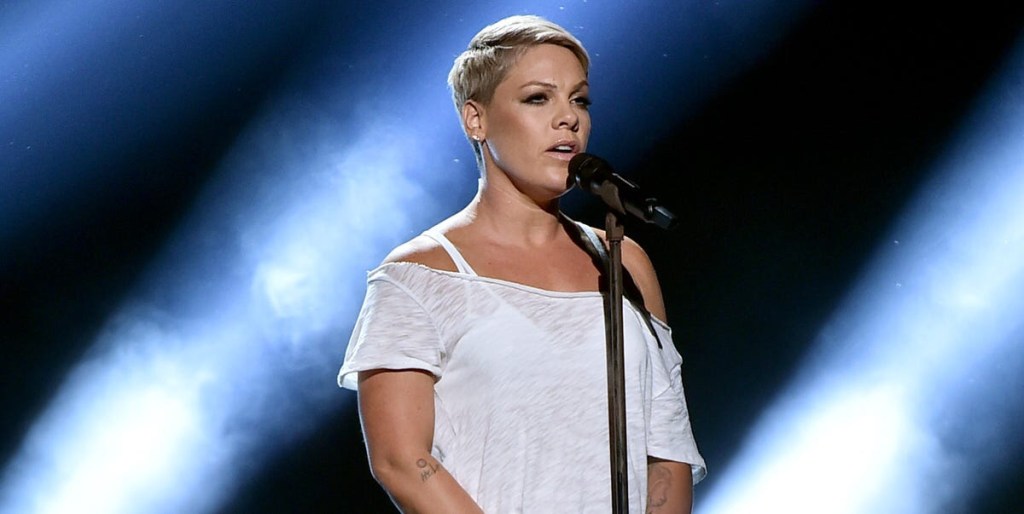
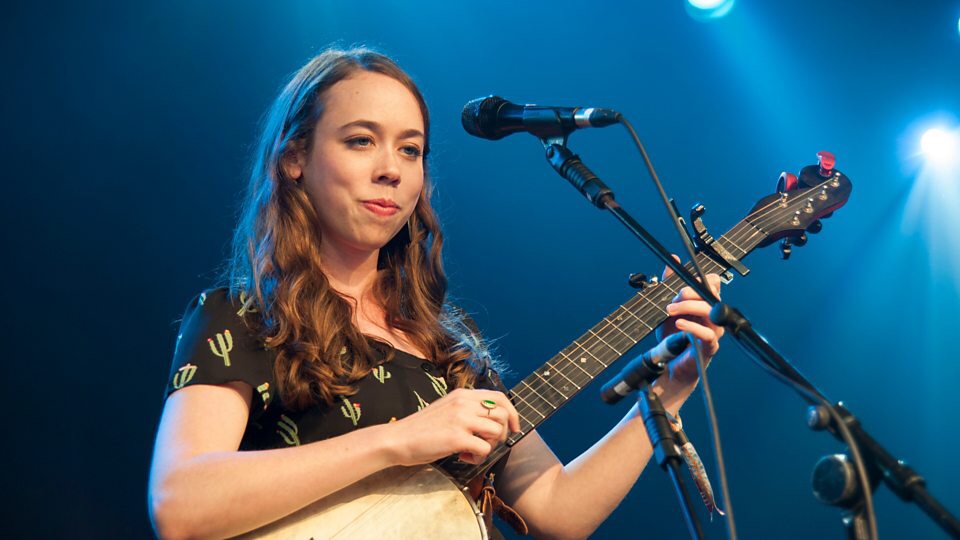
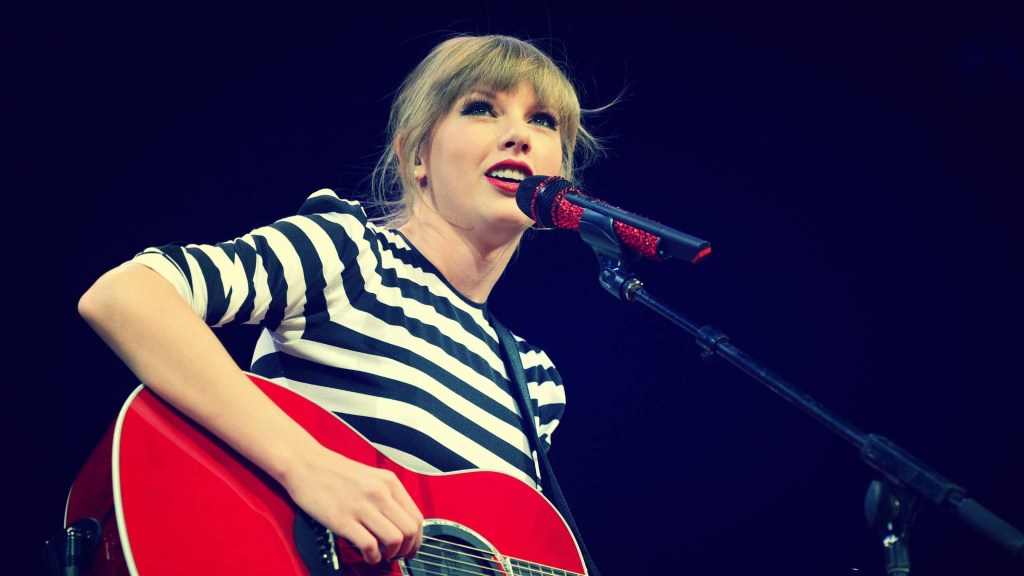
But the aviary is more diverse now. Three songbirds who are younger than me are high aloft now, your art reshaping everything I hear, and it feels fitting that all three of you are women. For flying high enough (you are the brightest star, after all) that I can hear you, along with two others, in everything around me now, I offer you thanks.
 Selling Dust