
Readers might want to see Women Talking before reading this entry, though one of its great strengths is that the film’s excellence cannot really be harmed by spoilers. It is my-entire-lifetime too late to worry that I am spoiling La Strada for anyone.
I don’t mind if something might be gaining on me; despite Satchel Paige’s advice, I look back.
When I asked you to look back with me, realizing that I’d known you for more than a decade without any sense of where you grew up, any sense of the Pennsylvania farm of your early childhood where you and your brother sold roadside fruit for pocket money, any sense of how you became the stunning performance artist and scholar of gender and sexuality you are, you asked me to look forward with you after sharing your story with me—“Why do you ask?” you wondered. The question caught me up. I had no clear response. I relate through retelling, entirely. Parties for me are chances to hear others’ stories; conversations I experience excitedly as crossroads where we can each look in all directions at what brought us together. Extroverted, yes. Exasperating, probably. I try to learn to reach gently and tenderly for the vectors inside us that propel us, Donnie-Darko-style, from there to here on the force of our narrations of our own lives.
Tracing artistic vectors, especially the vectors that have architected the particular cinema we’ve inherited in all of its heteropatriarchal dimensions, something I do obsessively—I need not be so gentle and tender. I am voracious in my search to grasp its history. I pull hard, very hard, to wrestle with the transcendentally influential titans who it’s so hard to get out from under in cinematic structure. When asked in an interview in 1965 to name other directors whose work he then admired, Fellini demurred, part of his crafted public image as an iconoclast who entered the film industry obliquely, first journalist, then cartoonist, then screenwriter, finally director; but he couldn’t quite maintain total silence on others’ work, and even while in mid-sentence refusing to name names he named names—exactly two, Bergman and Kurosawa, my two personal favorites in the pantheon. I celebrated a bit. Maybe I can bond with this fellow. Maybe Fellini’s vision, overdetermined as it is, is a vision I can learn to bring into focus as I study cinema. Like you, like Amy, like the Goat Island folks, I like to reflect on the vision of artists and on the implications of art.

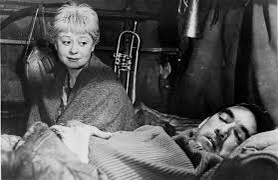
You helped teach me how art, when it’s doing its work, can physically affect us in the audience. When I saw your installation performance with soap in Chicago, I was not brutalized by it, precisely…I was moved to compassion for you, to rage at those in your life who have damaged you, those powerful emotions coursing through me in that warehouse-like space. When I watched La Strada, as I did just last week, however, I can be very precise: I was brutalized. The film prompted many strong and diverse feelings. Awestruck admiration at Giulietta Masina’s brilliant performance as a young woman sold into what is, in effect, slavery to a circus-style itinerant strongman, and who discovers her boundless curiosity about human life and her tremendous talent for clowning and thereby connecting with audiences while traveling in economic, psychological, and physical bondage to him. Rapt involvement in the breathtaking cinematic style of Fellini the artist, in his compositions and pacing and subtle engagement of me through camera placement. Performances like hers, directorial tours de force like his, these are the very experiences for which I so voraciously hunger when I look back at the cinema I have inherited and that stands even today in the tremendous shadow of films like La Strada. But more than anything, I felt brutalized.
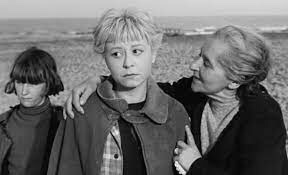
Molly, whom you’ve met and who removed your splinter at our party, departs from me as a film watcher, watching mostly action movies and similar stuff because these movies’ caricatures of human life don’t risk the deep emotional involvement that she finds too intense. I crave cinema of emotional involvement but, even as I do, rarely have too much trouble separating myself enough from the viewing experience that I remain relatively psychologically safe even in the bleakest and most challenging film contexts. To Fellini’s (and Masina’s, in large measure) credit as a formal artist, I could not achieve that while watching La Strada. Every time Gelsomina was demeaned and mocked, by her own family even, every time she was raped and beaten and deprived of her human vocation to dream for herself and actualize her ambitions by the monstrous cretin she felt she was coming to love and whom she hoped to marry, every single time, and these events were incessant in La Strada, these events the very vectors that propelled this entire narrative, every single time I hurt. I ached. I felt helpless. Unhappy. Desperate.
I’m asking myself now, as I write to you, why even as you put your own body on the line in visceral, immediately present ways in that soap performance, I do not count myself brutalized as an audience member by your art in the same way I do watching La Strada. I’ve talked often with Amy about how she responds so much more to live theatre and performance art, with bodies on the line as yours was, while I seem to focus so much energy on a mediated art like cinema. I’m still trying to work this out, but I know that I yearn for the immersive engagement cinema offers. I wonder if total sensory stimulation appeals to me in the ways it does because I am better able to attend to art in a darkened space in which all of us are singularly focused on one object rather than invited to acknowledge, even if only secondarily, the co-presence of bodies in theatre and performance spaces. Maybe I’m too extroverted, too much of a seeker for others’ stories through constant talk, to be as easily swept up in live performance as I am by the (mostly) enforced silence and stillness of cinema.
Another answer to the more precise question of why La Strada brutalized me more than your performance art, though, may be that I trust you more to keep me safe in that space, even in the moments you edge toward not keeping yourself safe as soap enters your mouth. I do not trust Fellini. His directorial gifts are so exceptional that, when combined with my willful giving myself over to cinema, I am entrusted to him in body and spirit. Most directors, even very good ones, as I noted above, don’t quite involve me as completely as he does, and his artistic power is exemplified by his getting me to entrust myself in body and spirit some sixty-three years later as I watch this film not in the movie house but in the darkness of my own living room. Entrusted, but not trusting.
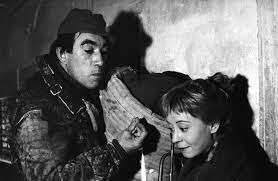
I trust you because the vision of human life in your art, even while the soap is in your mouth, is one of profound love and fellow-feeling. I geeked out on La Strada’s bonus features, as I always do in voraciously wrestling with cinema, and I heard the scholar on the commentary track defend Fellini against feminist critics who decried not only his brutalization of them through Gelsomina’s story but, notably, though she dies offscreen, the director’s granting the final scene to her vicious brutalizer, the camera sharing with us his solitary weeping on the beach as he grieves for her and, according to the scholar, begins to find his own humanity. I believe that I quite open to this argument intellectually, as my favorite author is Freire, who teaches me how systems of oppression dehumanize both the oppressed and the oppressor; I mean, Paulo figured that out without even witnessing The Evil Cheeto in action, and I find his boundless faith in the human spirit even in the most inhumane conditions to be the most inspiring writing I know. But the cinema of Fellini, as artistically astonishing as it is (I know three films, this one plus La Dolce Vita and 8 1/2), does not inspire me with its vision of human life. Intellectually, I could accept that Fellini urges us to believe in the power of transformation as we watch that final scene. Emotionally, I am physically, viscerally, nauseatedly certain that I, as one viewer, cannot stomach that notion; the very idea makes me want to vomit, a felt trace of both his aesthetic force and his departure from my own vision of human life. No one has taught me more about cinema than Robin Wood, whose central artistic transformation in his life was when, after coming out in his 40s and thereby losing his relationship with his wife and children, he could never again pursue his vocation, film criticism, by describing and embracing formal brilliance alone; from that point forward, what mattered most to him, he insisted, was the vision of human life a director’s work offered. I’ve read Wood in repetition more often than any author other than Freire, and never have I so deeply understood Wood’s evolution as a film critic as when I watched La Strada.
Wood’s evolution led him to focus primarily, in terms of contemporary cinema, on two perhaps oddly-paired types of filmic work: horror movies, the best of which he saw offering metaphorically rich critiques of state-protected capitalism and economic oppression; and cinema by queer creators, creators of color, and women. Cinema like one of 2022’s Best Picture nominees, Sarah Polley’s Women Talking. I don’t know if it will win, despite the intervention of powerful producers who are likely partly responsible for its being nominated at all, Frances McDormand and Brad Pitt. Polley was not nominated for Best Director. [Post-Oscar Update: Sarah Polley won the Academy Award for Best Adapted Screenplay, which delights me because I love this film but, much more importantly, matters because it meant that she was given the chance to speak about diversity and inclusion in cinema.]
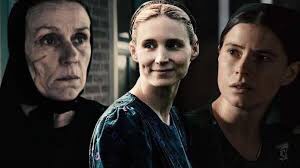
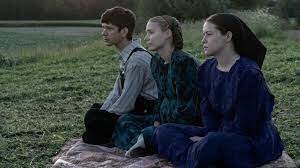
But Women Talking has my vote, as Polley combines formal excellence with a vision of human life that makes me feel healthy. Alive. Capable. Happy. Hopeful. All this despite it being, in many respects, remarkably similar on the surface to La Strada: A grim and painful tale of a community that chooses deliberately to live on the margins of society, a community marked by stubborn self-reliance in which the possibility of escape to freedom dangles always just at edge of the narrative, driving forward the conflict across a series of events that include rape as well as domestic and vocational bondage secured by gender roles and fear, all centering on a lead actor with an exceptionally expressive face that rewards the cinematic gaze. Incidentally, I used to think of Rooney Mara as someone whose access to plum Hollywood roles was purchased through some combination of her personal family wealth and connections (those Maras) and her ability to meet mainstream feminine beauty standards. After Women Talking, I will never make the mistake of demeaning this woman’s acting gifts again. My other favorite film of 2022, The Fabelmans, also made me think of Polley because it features the sparkling chemistry between Seth Rogen and the incomparable Michelle Williams, who remains my favorite actor—a couple previously paired in Polley’s Take This Waltz.
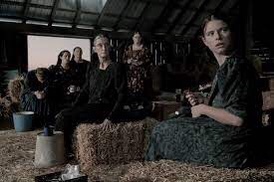
Polley’s outstanding work with actors is something I expected to see on display when I arrived at the theatre for Women Talking, given my prior experience with her cinema, and great performances indeed abound. I have also read and heard her comments on cinema and know that her values mirror my own. However, I confess that I was not prepared for how much formal excellence she displays as a director in this film. For its first twenty-five minutes, we are only rarely, for seconds at a time, given any view outside the confines of a barn loft, and through effective camera placement and editing we feel both the frustrating, anger-inducing claustrophobia that roots in our bodies the tight psychological and material constraints of the many women in this small space and also the warm intimacy that similarly roots in our bodies the possibility of shared strength that might enable release for them. The pacing of the film, given a screenplay that lives fully up to its title from start to finish, is quite effective in keeping me compelled by these conversations and their cascading consequences. Deliciously, in marked opposition to Fellini’s Bechdel-test-zero-scoring La Strada, no man (at least no AMAB man) appears in Polley’s film except in an oblique glimpse despite men’s actions having such a profound impact on the film’s characters. And the severe restriction of the opening act of the film is marvelously counterpointed, both visually and psychologically, with an expansive exterior closing sequence that can be best described, given what I’ve learned in my study of cinema, as Felliniesque.
Recognizing the genealogy of Polley’s directorial art adds to the enlivening experience of Women Talking for me. The complex cinematic shadow cast by a film like La Strada can obscure but can also interestingly illuminate, a notion that fits strongly with the chiaroscuro visual palette of both films. I had no idea when I saw your performance in Chicago that it would a decade later illuminate my effort to make sense of these two films that are strikingly similar cinema yet strikingly at odds where it matters to me most. That’s why I disagree with Satchel, though, why I think he has it backwards: I think that I gain something when I look back.
 Selling Dust