
FIRST: One player looks in at another. It’s reciprocal—the other player looks out at the one looking in. When we talk baseball, you and I, we use these phrases, these distinguishing conventions of perspective—pitchers “look in” while batters “look out.” Sure, the convention fits the geometry, foul lines converging narrowly at home or, the other way around, foul lines widening to make the field of play and (vertically speaking even if horizontally walled by the outfield’s back edge) extending into infinity; the two phrases with “in” and “out” make sense. But when we talk tunes, you and I, we know that phrases make sense in another sense of “make.” Phrases are units of meaning bigger than notes, and phrases make music what it is, interplay between physical vibrations of air and our perceptual faculties. Phrases make hearing into listening, sound into music. And in baseball, “looking in” and “looking out” make sense of the beauty at the center of the game’s design. It’s interactive at its heart.
Reciprocal, responsive engagement initiates everything in baseball. In other team sports, at least the ones I know in our culture, one side could simply stop resisting, slack, allowing the other side to accomplish all of its goals in the game. There are no “goals” in baseball that anyone can achieve without reciprocal action. Goals only make sense when players first engage one another.
This is why the “automatic” intentional walk is such a poor new rule at the highest level of the game. Major league catchers rarely lapse in receiving or in scanning runners; major league pitchers rarely throw wild pitches in those situations. So yes, the game-event impact of making the pitcher/catcher pair accomplish the task is negligible. But simply awarding the base, not as a result of an action on the field such as a balk or an interference call but simply because of a manger’s decision, profoundly violates the first and most central quality of the game’s beauty: All events are initiated through interaction.

SECOND: What’s the minimum measure of music? One note hummed might be music, but maybe not. Maybe that’s only sound. Does one swing struck on the rim of a drum make rhythm? Wouldn’t rhythm require combinations of strikes in time? Wouldn’t music mean more than one note in intervallic relation? Sounds in sequence against silence (and even interacting with silence, as Miles maintains) create music out of nothing, literally and not just figuratively out of thin air.
The minimum measure of baseball is one pitch, an interactive unit. One player alone is not yet playing in this relational game. The minimum measure is one pitch, even if that pitch is offered as part of the “through the motions facade” of the intentional walk, as I think it should be. In principle, a game could end with a bat never striking a ball. Let’s say the home side throws 81 strikes, called or swinging, perfection of perfection. They’re up in the ninth, and the same thing is about to be done to them, but on that 81st pitch the catcher drops the ball. The batter/runner is very fast, and scores on the dropped third strike as the catcher stumbles around while the ball ricochets between the dugouts. A bizarre scenario almost certain to never happen, but it illustrates another beautiful feature of the game’s design: The game is its own engine.
A game of baseball is created by a sequence of pitches. Other team games’ engines are a ball or puck propelled or carried in a specified direction; they are all, basically, war games of one sort of another, the game created by movement through territory. Baseball requires no conquering; it doesn’t even require striking the ball, as in my preposterous thought experiment. Baseball requires only its core internal responsive action, a pitched ball offered to a batter, and everything else…homers that land in the bay, circus catches with center fielders leaping in midair, blazing baserunners streaking to the plate…is a consequence of that core internal action. No exceptions. Yes, I will exalt the gorgeous sound of the four-pitches-required intentional walk. Baseball is not a war game, and you can’t just surrender a position in this inherently interactive game because a general signs a decree. No exceptions.
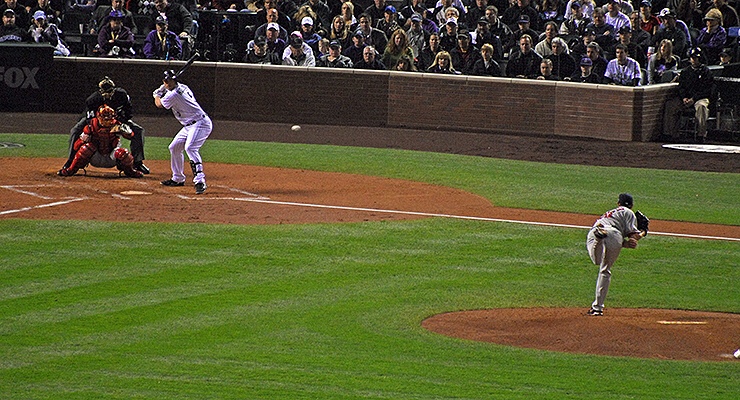
THIRD: Sounds are a powerful part of the experience of baseball. A throw pounding into the glove. A crack of the bat. These sounds share a common root in responses to the flight of the ball, another beautiful feature of the game’s design. Like air that flows through amplifying columns (throats, bells) or along the length of a vibrating string, baseball sings each of its songs through the moving ball itself.
Outs are recorded by defensive players striving to control the ball…to execute the pitch, to catch a struck ball, to make an accurate throw. The most controlling way, though, holding the ball in the glove, has limited usefulness to the defense; the responsive, reciprocal nature of the game demands that the ball be pitched and that the other side have the chance to swing, run, and land safely on a base. Tag plays are the rarest kind of out, and even these are meaningful only because a runner exists; the moment that third strike is dropped, batter becomes runner, and tags now matter, because all players involved must respond to the ball.
The ball itself along its moving path makes meaning out of all actions. A static ball in a pitcher’s hand is mere potential, but according to the game’s laws, a ball in flight creates energy, demands action. This is the most musical part of baseball. Music matters when we learn to listen to one another, audience to artists, player to player. Music sings its song when we share sounds with one another. Baseball sings its songs when the ball dances.
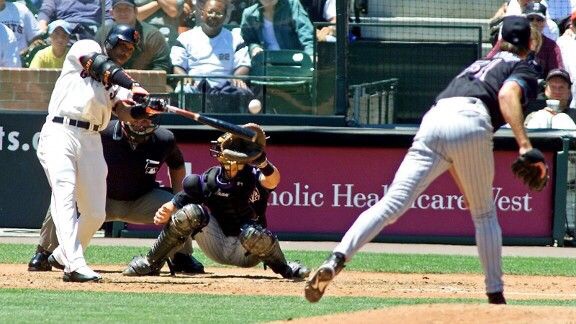
FOURTH: Dance means responses to rhythm, heard or imagined. Rhythm unfolds in time. Yet the most difficult thing by far for me to learn, as a beginning piano player in middle age, is that rhythm unfolds not through counting of external mathematical time but through internally created patterns of note values and tempos. Even when I turn on the metronome to try to measure myself, musical feeling matters much more for making it sound right.
I should grasp this better, despite my limited musical performance education, because baseball teaches it so well. Writers long before me have exalted baseball’s needing no clock, the game unfolding through its own structure of 27 outs on a side rather than by crunching its events into seconds, minutes, and hours. The time signature that measures baseball’s inexorable waltz is an elegant series of trios: 3 x 3 x 3, three strikes, three outs, nine innings, 27 outs, 81 pitches. Other than in my thought experiment, though, it’s never actually 81 pitches; even the weakest offenses distort that set of perfect trios with pitched balls taken wide or low or high, with balls fouled off or swatted into play in the pursuit of a trip around the bases, lengthening the trio’s perfect circles into lines and squares.
I love the expansiveness this creates, how a team at bat can be, in principle, at bat for a month until that third out is recorded. It makes the game feel infinite. Yet anyone who lives the game knows that its flow feels much more tightly wound than that, offensive hopes unendingly thwarted, heartening sequences of safe hits and steals cut ruthlessly short by the oh-so-sudden advent of that third out. Baseball, unfolding along its own rhythm, creates an astonishing accordion thrumming between the infinite possibility of offensive accomplishment that stretches ahead between those unending parallel foul lines and the limited reality of defensive confinement as the pitcher stares in toward the plate where painted lines and pitched balls converge upon the batter. That, my friend, is a rhythm.
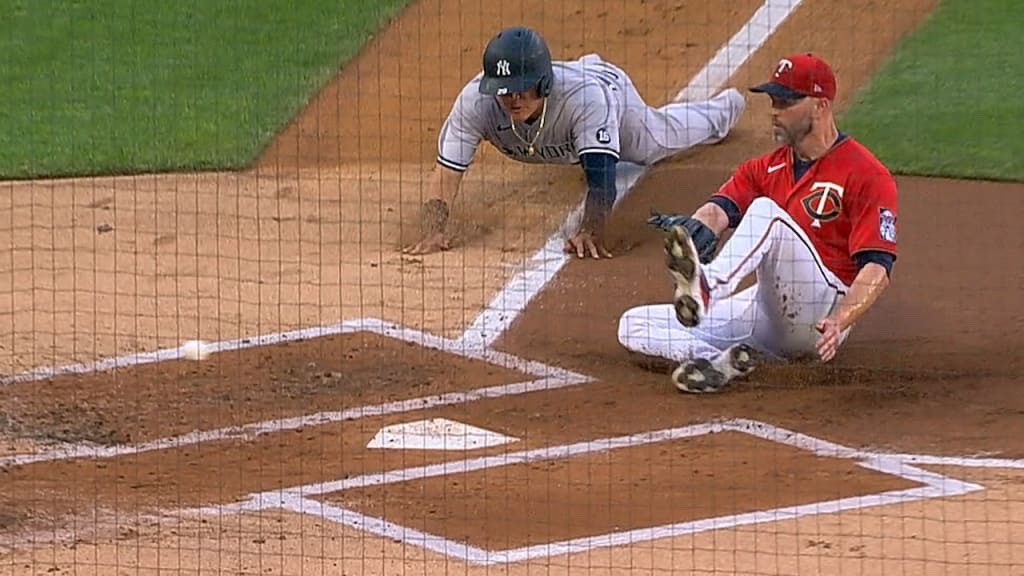
FIFTH: You tell me that the music I am playing, even in my halting beginner current state, is not in the score or in the instrument but in me. When I try to feel rhythm, I notice this: The simplest musical rhythm is not the elegant series of triplets that creates the inner tempo of a baseball game but the two-step, the march, the back-and-forth that signals equity, equally shared opportunity. Baseball indeed insures equity; unlike other team games that often end with one team stalling tediously, dully, inelegantly, in baseball the infinite possibility of offensive accomplishment means final at-bats are certain unless the home team already leads. Half innings come in pairs, it would seem. But surely, equity in baseball is guaranteed in the most elegant way, yes—by cycling through the triplets of strikes and outs. Turns at bat aren’t bestowed by a moral precept of fair play external to the game; you’ll wait your turn forever until you secure that precious third out.
What must be secured at all costs in other team games is the ball; possession means everything, and turnovers are the ultimate sin. But like a thrown ball popping loose from a glove squeezed too tightly, in baseball possession itself has no meaning beyond the flow of play…in baseball, possession does not define play but is defined by play. Baseball’s two-step is rooted not in evenly divided half-innings per side, which are really just subtly hidden paired triplets of outs, but in the exchange of pitcher and batter. Baseball’s equity’s in interaction, the game’s progress like in the tightest jazz ensemble achieved in interplay and not in authoritarian prescription of what must be played.
And these rich combinations of duple and triple meters, like in so much music you’ve shared with me, like in Elvin Jones’ drumming, shows us the extraordinary patterns glimmering in baseball’s gemlike structure. Two players intertwined, pitcher–batter engagements originating all actions. These players in their roles dancing through a series of triplets, three outs outlining the game’s unfolding. Four balls the outcome the pitcher strives to avoid. Four bases marking the batter’s path home. These common meters, these twos and threes and fours, undulating between the zero point of home plate and the infinity of the field of balls hit fair. Baseball’s beauty rests not only in its founding impulse in players’ one-to-one interaction through the medium of the pitch but also in its internal fractals, its broadest interactional opportunities of outs and runs emerging in patterns created by its smallest elements.
SIXTH: The game, like the music you and I share, reveals such glorious, ethereal patterns; but also like music, baseball is fundamentally human. The interactional character of pitcher-batter negotiation for control of the strike zone includes both catcher and umpire, who become key players in that negotiation and help ensure that the game is never reduced to mere mechanics.
For some, this is a flaw. Some favor a digitally aided umpiring system calling balls and strikes with laser precision. Not me. The strike zone and the ball’s relation to it are constituted in process by internal elements…batter stature, batting stance, pitch vector, and so on. This is the nuanced negotiation that initiates play and that makes each pitch a unique, unrepeatable act. Catchers complicate this negotiation, and I believe umpires should too. It’s why the pitch clock does not trouble me. Umpire judgment, especially at the level of balls and strikes, already shapes the game. Clock time, including on the pitch clock, is external to the game and does not distort the unfolding of the game; a strike or a ball, the only consequence of failing to beat the pitch clock, is already a consequence every time the pitcher toes the rubber. As innovations to make play more snappy go, this one tugs nowhere at the integrity of this beautiful game.
Electronic strike zones erode the negotiation intrinsic to the game as much as instant replay. Until instant replay, every event we saw in baseball was real, rather than subject to the possibility of being rendered unreal by a later ruling akin to the foul calls, waved-off goals, etc. that undermine other team sports. Though I’m not sure I would have handled it the way he did, I fully respect George Brett’s outrage in New York in 1983; in baseball, a home run is supposed to be a home run—the moment it is called fair in live action. Instant replay is as unmusical as autotuning. After all, without “wrong” notes we’d have no jazz.

SEVENTH: Still more mimetic matches between these arts you and I love, music and baseball, matches resting once more in how both baseball and music are built up from smaller elements that flow into larger structures: The sanctity of the pitcher-batter interaction that roots the game means that every event can be documented. Detailed box scores are the extreme example, the ones that document each pitch. But even old-school box scores in the newspaper allowed kids like us, in the fashion of musicians imaging their way through lead sheets, to get ink all over our fingers in the 80s and early 90s as we tried to reconcile the entire game, batter by batter. We could see Kirby Puckett’s number of ABs being smaller than Kent Hrbek’s just below him, and we could infer a BB or an HBP that we could cross-reference to the other team’s pitching tally. We could see that he’d scored a run on an 0-fer day and track down the FC or the opposition error. Outs aren’t totaling up snugly? Look for that sneaky CS!
There’s nothing even remotely comparable to this in other team sports in our culture. A goal or an assist is just a bare, untrustworthy snapshot based on a scoring outcome that describes none of the incremental activities so vital to the outcome, the passes and picks and surprising headers—and accounting for football events is just patently ludicrous. But in baseball, if we choose, we can bring every double legged into a triple, every snap throw from behind the plate to nab the runner leading off first, even every single foul ball, to vivid life in our mind’s eye in a game we never saw, a game a day or week or even decade old. We can do that exquisite tracking because in baseball, each action is incremental. Each action is incremental because in baseball, each action originates in a precise interaction. This is true not just of pitches and hits but of all actions…outs can be recorded by baserunners, and errors are charged on dropped foul balls even when they don’t result in a base gained. In other words, mutual responsibility for responses in baseball persist even when balls are beyond the pitch and now in play.
Baseball, I’d say, is unique as a team game in which each player must engage not just by covering ground on defense but also by taking a turn at bat and engaging in documented interaction—true even with the DH, because pitchers are responsible for more interactions than anyone else and DHs bat. Baseball is a series of solo responses that weave together to make a whole game. Baseball teams, then, might be better named baseball ensembles, to honor that mimesis with music. At least we go partway—we call them clubs.

EIGHTH: When you and I listen, you help me hear how in an ensemble, each player shapes the sound in some meaningful way, however small. It’s in this sense that the idea of ballclub as ensemble really comes to life. Yes, the pitch is the fundamental unit of interaction, the movement of ball between players flowing like sound and shaping responses…but the outcome of interaction, the punctuation of each episode, rests with each player.
So I love that we credit all outs to pitchers (“Maeda went 6 and a third”). I love that we attribute offensive results to batters, even when other players were obviously involved and even though it results in colorful language with funny images if read outside baseball’s meanings (“Correa popped out to third, reached on a fielder’s choice and was caught stealing, then flew out to center”). This isn’t just reflected in box score accounting but in the units that determine the outcome of each game: Each player, in order at the plate, reflects the outcome in small bits that build up gradually, by counting as either an out or as a run (or a portion of a run, by becoming a runner). No exceptions. Even compared to other sports that register counts of just one goal at a time (not to even mention the abominations trafficking in “points,” horrifyingly), this is very elegant. Every player is counted, and every player counts.
And this is why the placement of a runner on second to start each extra inning rankles me. I’m not a traditionalist just out of nostalgia; I like the DH and have no qualms about the pitch clock. Even the “just give them the base already” current version of the intentional walk and the use of instant replay, while I offer quibbles about them here as I philosophize about baseball, don’t strike me as disrupting the core of the game or its flow to any great degree. The truth is that when I watch games that go into extra innings now, the new bonus runner makes the game more gripping. But it’s so inelegant. Who is this runner? How do we account for this runner in the structure of interaction originating play and all of its ensuing responses? How can we say that any pitcher is responsible for this runner? If the runner scores, under which self-generating act can we credit the runner’s arrival on second? Inelegant. Discordant. Not just atonal, this runner, but hurtful to my ears. This runner makes the game less beautiful.

NINTH: Ninth inning magic is unlike any other magic. Extra inning games work well when they extend that special ninth inning magic, but in my experience it’s rare. I attended an 18-inning A’s win in 2013, and the truth is that a regular season game like that, even with a team fighting as the A’s were then to hold a division lead, lets the tension slacken when it goes that long. Gene Larkin’s single technically happened in the bottom of the tenth in October, but you and I both know as baseball fans always know that that hit ended 1991 and that that hit was ninth inning magic.
So I have to save the most beautiful aspect of baseball, of its stunning perfection as a game of responsive interaction, for the ninth. For me, it’s not the absence of a clock. It’s not the duple-triple rhythmic interplay. It’s not the box score’s completeness. For me, the game is perfect in the way every action involves a small, tightly wound ball inviting engagements with it that are imperfect. Halting. Little failures in which we strive to do our best, knowing that failure is inevitable and that the game, in all its geometric, fractal-spawning glory, is always inexact.
People have claimed since we were kids, and probably for much longer, that hitting a pitched baseball is the most difficult skill in all of organized sports. I don’t know if that’s true. I’m not a good judge, given that I can’t swing level enough to square it up off a tee. But it’s interesting that accomplishing your goal as a major-league-level professional hitter even 40% of the time, even if we count OBP and not BA, is achievable year in and year out by only a few players. What I love about this, though, is not just how hard the game is, for hitters and for pitchers, but how imprecise. Yes, the strike zone is a narrow rectangle twenty-plus yards away in which some pitchers can locate spinning baseballs with pinpoint command…but not every time. Even Maddux never threw 81 strikes and no balls, and he was about as capable of that as anyone in our lifetimes. A “perfect game” still yields imperfect pitching results, some called balls, even if the offense never puts together so much as a walk. Imprecise.
Most compellingly for me, imprecise strongly characterizes every action in baseball other than a strike taken in the zone. Every pitch called a ball (even to Bonds), every ball fouled off (even by Boggs), every bunt (even by Carew), every hit placed behind the runner (even by Knoblauch), they are approximations. Near misses. Near misses that can yield results when the pitcher or the catcher or the fielder can’t react as they intend—but still near misses. Balls are imprecisely directed, and through that players respond, and the game is created.
How stark, how stunning, this difference from other team sports, sports in which precise placement wins the day. I’m not thinking of passes and kicks that are more precise than batted balls (though in most high-level games they are more precise). I’m thinking of hoops and nets and yard markers and goal lines—the things that frame the aims of players in these games and, thereby, combine with a down-counting clock to make these games what they are. Like the ticking clock, these games and their engines are all about precision.
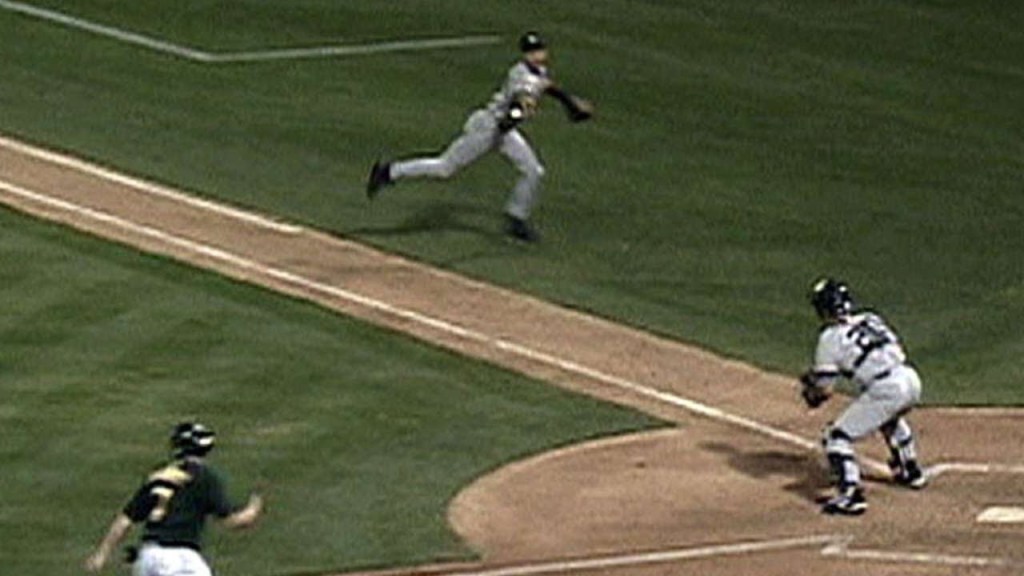
But not baseball. Batted baseballs, even line drives, come off the bat obliquely, round barrel against round sphere, and carom off in unpredictable arcs. All the defense can do, when the pitchers’ failure greets his team and a ball’s been struck, is try their best to size up that vector and run the ball down. On the ground, in the air—run it down. Yes, foul lines define the territory of fair play, and bases align in a rigid square—but that merely creates possibility, for advancements and putouts. These lines and squares are otherwise irrelevant to good defense, because like every other aspect of the game, it’s only the flight of the ball that matters, only the flight of the ball that makes responses meaningful. Though I grew up reading stathead analyses that would lead me to wonder if he was overvalued, and though anything adding to the Yankees’ postseason legacy revolts me, I admit that I admire Derek Jeter because he understands this, my favorite aspect of this beautiful game. Balls in flight, imprecise and unpredictable, invite responses, and that’s what matters, and his response on that night in Oakland was as inspired as any response ever.
So yes, I can accept the DH and the instant replay and the electronic ump and the pitch clock and, maybe, even the extra inning runner. But the repugnant atrocity that goes by the name of “shift ban” damages the game, I maintain. It rips at the tapestry of baseball. It brings in an assessment of defensive players’ placement and, worst of all, defines territory as a component of action; these things have no precedent in baseball, and they have no place, for all the reasons I suggest here. Even though it will surely benefit my favorite player, Matt Olson, I fear that the “shift ban” deprives us of a small part of the magic I associate here with the ninth inning. Unlike any other rule I know, it makes the game a bit less beautiful.
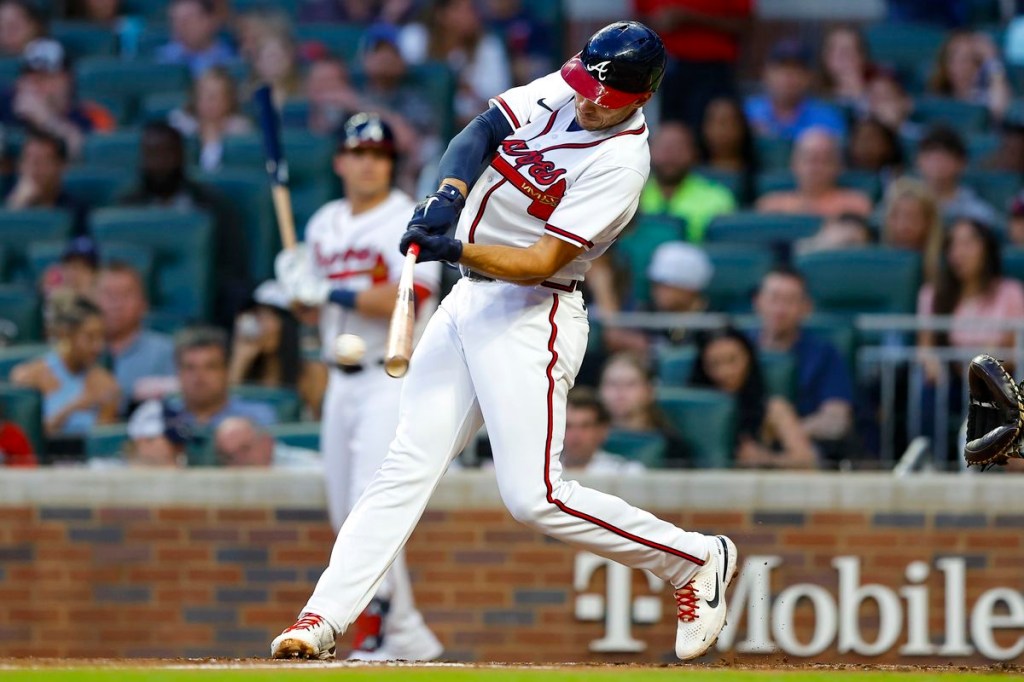
Rule changes at the professional level though, are just white noise. Instruments evolve; voices change as we age; yet music survives. Human achievements are imperfect and marked by striving, and that’s what makes them worth our time. The structures underlying the striving are the ideals that set our striving in motion. Music survives because music, like baseball, is perfect.

tl;dr
or
I’m not interested in your attempts at vaguely poetic prose, or your musings about music, or your friendship with some Twins fan—I just want to know what makes baseball so special and so different from other team sports.
or
Wow, this writer really likes Stephen Jay Gould
- The pitcher–batter dynamic in baseball requires two players interacting directly to initiate the game, setting the game in motion as a series of linked responses.
- All events in baseball derive from the outcomes of pitch-level interactions of pitcher and batter, and nothing else happens in this team sport, no other action is meaningful, until this two–person game–within–a–game has a specific outcome.
- A game progresses through the recording of outs, so the underlying structure of progress is consequential rather than sequential, emerging from a unique series of events in each game in responses to balls in motion.
- The flow of time in baseball is created by the cascading structure of interactions within the game itself, rather than by the elapsing of minutes on a clock or by the reaching of a prescribed constraint involving movement through territory.
- Teams do not change roles (defense/offense) until three outs have been recorded, so opportunities for baseball accomplishment depend solely on the outcome of interactions between players rather than on achievement of a precise goal on the field of play or arrival at a predetermined score.
- Baseball’s game–within–a–game of the pitcher–batter interaction features a nested set of negotiations of meaning, without which the game cannot proceed: The pitched ball must be caught and returned by the pitcher’s team, and the pitched ball must be assessed by the umpire in relation to the batter’s response.
- Accomplishments in baseball are incrementally marked by both bases and outs, and outs can be made on the bases, so the responsibilities for particular interactions endure beyond the initial pitcher–batter interaction, and these responsibilities can be linked to each player—making each player a component of the game’s flow and not just a hidden participant in a team’s efforts.
- The total possible outcome of any single pitch is either an out or a run, a player–level accounting rather than an accounting based on tracking scores solely by what happened to the ball itself.
- Baseball accomplishments do not depend on directing or redirecting the ball precisely toward or away from a goal but, for both defense and offense, on responding to the unpredictable and imperfect arc of a ball in flight.
 Selling Dust