
Mushrooming awareness. Earth, mucky/muddy/murky, somehow sharpens in resolution. Sharpened, each shard of light glints. Sharpened, present with a force leaping toward my eyes. Sharpened further still with the full unboundedness of light’s links to an infinite latticework of vision, and sharpened further still with the pointillistic precision of light’s particular position. Trip—trip is apt, trip terms how my mind is not merely taught the physics of the photon’s fascinating dual nature but is freed for those few fleeting hours to feel along with each photon, freed to feel at once in the sharpened photon both the flowing stream and the singularity.
You, a singularly influential author in my life, have taught me so much about cinema through your marvelous essays, your individual voice leaping off the page and enfolding my understanding of film, of feeling, of art. So I write this to you though you survive no longer in your physical body but in the minds of your readers like me. I write to you because when I reread, you continue to teach me so much about cinematic form and function.
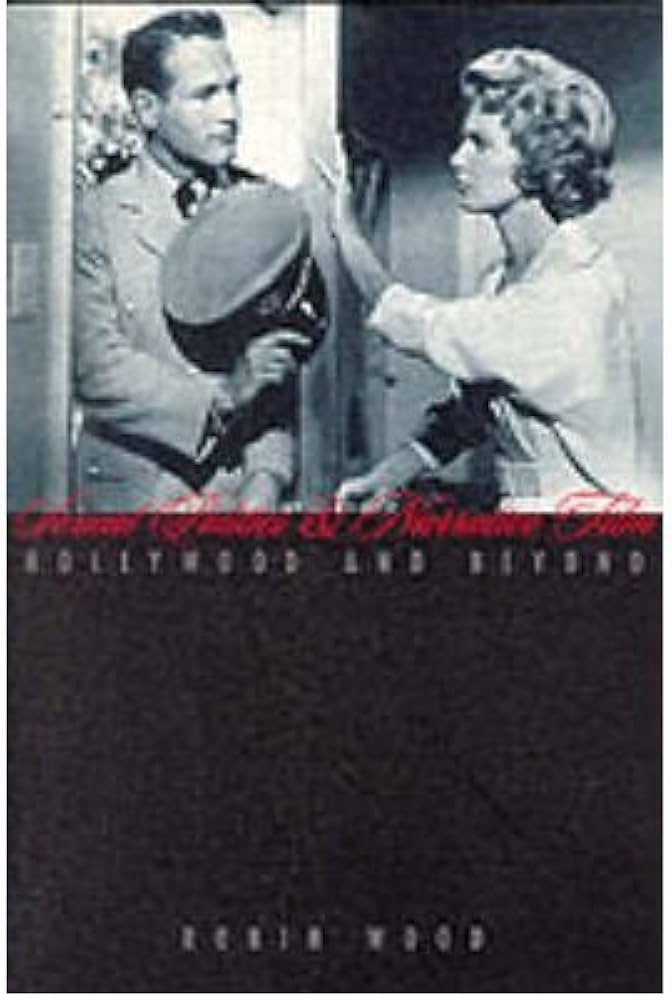
Cinema fumbles in efforts to capture the sharpness of singularity. Moving pictures cut definitively against the singularity; the form itself montages the photon into motion. Images smudge into simulacrum. And it’s not just film’s form but its function—close up after close up oversaturates our contact with actors onscreen in this most socioeconomically rarefied, ultra-resourced medium of Marilyn-Monroe-manufacturing multimillionairity, so that the rapid juxtapositions of glowing faces are not just contained within the frame of one film but run from performer to performer and from role to role. Fight Club would fail as a film without Brad Pitt playing the projection of Tyler Durden’s alter because even as I read the novel, Palahniuk’s prose posited Pitt without needing to name him—collective consciousness of preposterously-gorgeous-tough-but-not-too-muscular-smooth-skinned-edgy-snarky-arrogant-still-smartly-witty-always-cool hypermasculinity within American white supremacist patriarchy was absolutely cinematically concentrated, in the exact cultural arc between the novel’s 1996 publication and the 1999 movie, in the image of Brad Pitt. You write sometimes in your essays about the need to study the cinematic function of the star, of the image that persists within one actor moving across films and roles to inflect those texts with particular meanings. Stars persisting as metonyms across texts—what a brilliant way to highlight how cinema and culture weave into one another. Star is apt, too—a star the pinpoint of light that meets our night-sky-turned eyes but that is never only a light unto itself, always also twinkling toward the bed of indigo-black in which it rests and toward the milky auras of fellow stars. Flowing stream and singularity.
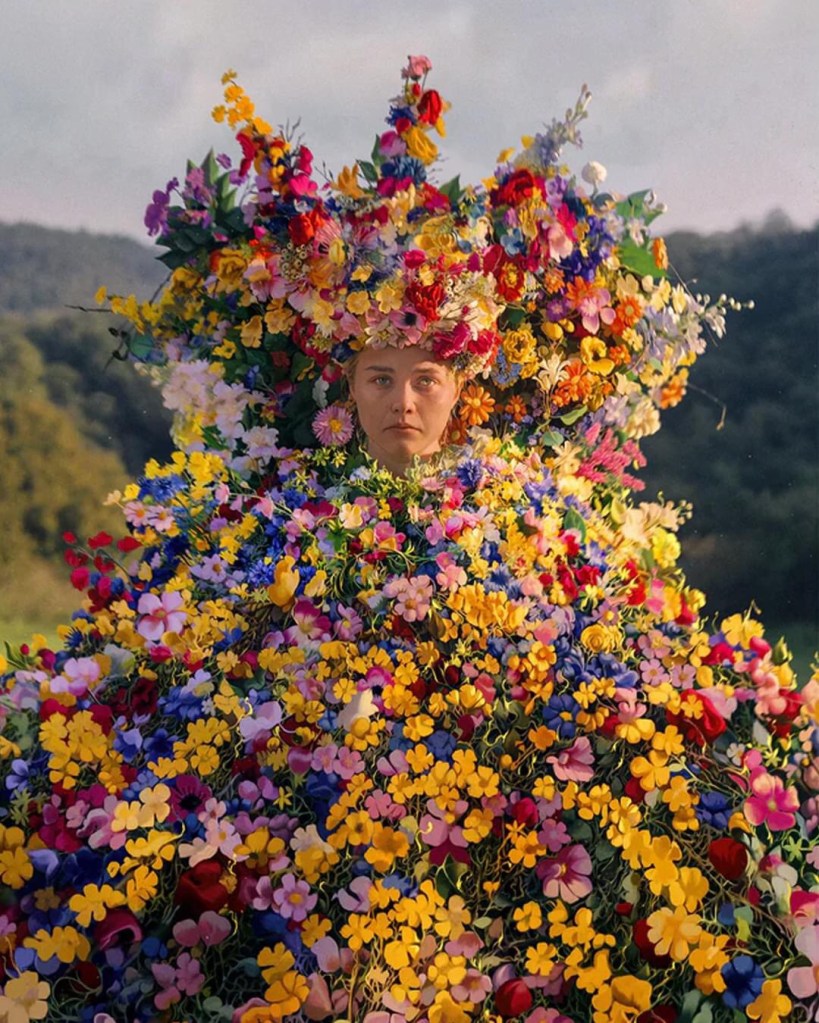
Midsommar is a film I wish you’d lived to see and study, because you write not only about the star image but about how horror films frame the long-rooted rhizomatic spores of our cultural consciousness. I find these the two great strengths of the film. Midsommar strives to capture the sharpness of the singularity; Aster the director has to try because one way to read the film is as a single shroom trip itself. The opening montage conjures the visual sense, a forest of fog-shrouded trees and a maze of nighttime urban canyons rhyming into one another in the ways lines and shapes do when shrooms are in play. Structurally, too, we move from a claustrophobic prologue of failing connection, mental illness, trauma, and alienation through the vertiginous aperture of a perspective-turbulent psilocybin episode and then outward to unending brightness, pastoral languor, mystical symbology, and violent paranoia—absolutely consonant with a trip, one that in cinematic time stretches into what feels psychologically like eons (especially in the 171-minute Director’s Cut). The pagan nature worship riven through the film rhymes also with a shroom trip’s returning the mind to normally-numbed sublime awe at beholding heavens and earth. You write often, as you explore the genre, of how horror holds us up to what we collectively repress. Midsommar stages sex as ritual to raise the profile of tensions among consent, community care, and individual pursuits of knowledge/pleasure/perpetuation-of-self. What we repress, the film suggests, is rage—rage that stems from our relational and social anxieties about betrayal, abandonment, our failure to reach one another. The commune at its center, true to the feel of the shroom trip, is a thick palimpsest of meaning, every surface etched with runes and drawings and textures, every landscape an abstract sketch of vectors and parabolas defining what might be apprehended if only we could deeply touch, deeply look, deeply listen.

And what the film invites us to listen to most deeply is the titanic howl of Florence Pugh, a clinching substance holding these 171 minutes somehow together while she bellows her grief, shrieks her terror, wails her isolation, and roars her vengeance. Just prior to the first moment of onscreen violence, Pugh slowly amplifies her breathing toward hyperventilation, a clairvoyant and sympathetic vibrating with the elderly woman perched on the precipice high above her. Just after that moment of the two elders’ shared suicidal fling, all of the attendant villagers groan in collective sympathy with the agony of the still-breathing elderly man, anticipating how the women of the village will mimic Pugh, how they will endeavor to put her voice in their own bodies at the film’s orgiastic and death-delivering climax. But even in the orgy, even in the determined deaths, our most enduring echoes still cannot bridge the chasm that separates our bodies from one another. Sure, the old saw holds that at the point of death we’re each utterly alone, but Scarry shows how this is no less so in life, shows how when the body is most alive—how when the body is in pain—we most clearly, most sharply see that we cannot share our existential sorrow. What a trial for a cinematic actor, even a star, this burden to bring to life the singularity of existential sorrow along the flowing waves of light and sound. May Queen indeed, Pugh makes those existential pains as palpable and powerful as cinematic mimesis can get.
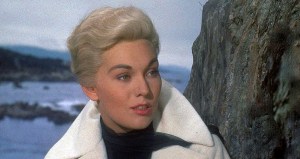
One of your most compelling approaches to studying cinema is how you so often show the failure of an auteur like Midsommar’s Aster to wholly command the complex interplay of elements in a film text—from polysemic audience reception conditions to tangled production team interventions to spectacles summoned by unique casts of stars. Hitchcock is your favorite example of film’s textual instability against the grappling claws of the auteur, though you also examine DePalma from this perspective. DePalma is notoriously haunted by Hitchcock, and two films you foreground as chaotic cinema indicating artists’ repressed and uncontrolled impulses are Vertigo and Obsession. Both of these films haunt me in a different, quite specific sense—they simply have never worked for me, despite the latter being according to you one of DePalma’s best and the former being according to seemingly everyone a definitive Hitchcock masterpiece. Each has as its central conceit an actor—Novak, then Bujold—playing a double role, each a single woman (not quite in Obsession, but given the double casting of mother-daughter Bujold the point holds) who is so egoistically flattened by the clutching and callow consciousness of a male protagonist that he supposedly can’t see, across innumerable intimate interactions, that it’s the same…damn…person.
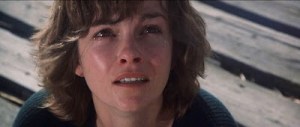
According to your claims, I think I’m meant to surrender myself to the fantasy of the motion picture, meant to suspend my disbelief so that I can be rewarded with a meditation on the self-blinding and other-negating of the male gaze through the lens of that gaze’s most notorious artistic medium, cinema. But experientially, the double casting throws me, bewildered, out of the fantasy—true the one time I’ve watched Obsession and still true the several times I’ve watched Vertigo. DePalma evidently imagines himself to be embracing this position, twistedly, when in an interview with Noah Baumbach—Greta Gerwig’s partner, no less!—on the Criterion edition of Blow Out its director DePalma glosses Godard on the purported “a gun and a girl” foundations of cinema, as an art which shows the audience something we’ll wait with baited breath to see in subsequence. Yet in making this reference DePalma’s own language brutally objectifies—holding up one hand for gun and one hand for girl, he says that what we viewers expect is for “it” to go off or for “it” to undress. The immense weight of such multilayered patriarchal withering of human sensibility makes me despair for my capacity to recognize not just the value of Vertigo but something you also call for with a voice of desperation in your own writing: the possibility of empowering performances in cinema.
As for empowering performances, though, by Pugh I’m empowered as an audience member—rather than thrown out of film narratives and turned away from characters’ sensibilities, by Pugh I feel light leaping toward my eyes, pulling me in, turning me toward her characters’ consciousnesses. Before I’d watched Midsommar (twice now) or We Live In Time (for which I fervently believe Florence Pugh should receive all available award recognition for 2024 achievement as an actor), only a few short weeks ago, I couldn’t see this, couldn’t hear it or feel it. I was adrift amid the most insensible of flowing streams, the incessant noise of contemporary media that masquerades sometimes as social synapse and sometimes as commercial mass. I vaguely ascribed to Pugh my great disappointment with Oppenheimer and my misapprehensions of her comments about her much-discussed red-carpet costumes, and I thought in parasocial punkery that I didn’t “like” her. This is the kind of nonsense that passes for a “response” in a degraded art form, in a degraded culture, and I aspire through this writing and in my other work to cultivate more humane, more apt responses to art and culture broadly and to the great artist Pugh in particular. Displeased with myself, I imagine the preposterousness of saying to Helen Mirren from across an end table, for example, “oh, I saw that Caligula film, and I saw you on a talk show once. I don’t like you.” The look I’d deserve in response from her would desiccate me to ash on the spot. I can imagine, moreover, such a look, such a response, from Pugh—she unleashed that look in both Midsommar and We Live In Time when the moments required, and never the barest instant before. Performances as perfectly positioned as a fleeting photon.
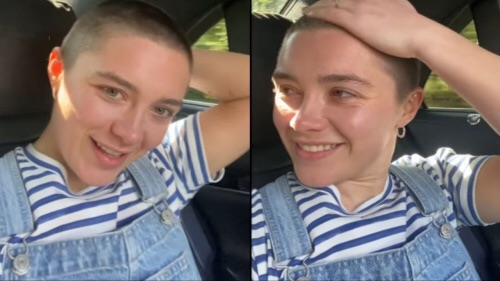
As for fleeting instants, I had the chance to recognize this actor’s greatness much earlier but didn’t catch on because of that most overwhelming of derailing temporal juggernauts, the COVID-19 pandemic. Seeing Gerwig’s Little Women in the theatre with two colleagues, one of whom is an Alcott ultra-expert, was the last social experience I had before we all shut ourselves away in March 2020. I love the film, but its literary omnipresence and casting ensemble (Saoirse Ronan can make it hard to pinpoint even a star as bright as Pugh) helped keep me from the shroomian sharpness spurred by my more recent-week cinematic trips. I take a tiny measure of solace, though, in my reading of even Vertigo, a film you valorize, being bolstered by my striving to appreciate Pugh’s work. Double casting might too-accurately serve as synecdoche for a film about the narrowness of heteropatriarchal desire and more deeply for this artistic medium’s flattening of humans—especially women—into types. But across films, as a star now visible for me even amid the flowing stream, there is no type that can meaningfully contain the singular artist Florence Pugh.
 Selling Dust