
I hear the ancient footsteps
Like the motion of the sea
Sometimes I turn, there’s someone there
Other times it’s only me –Bob Dylan, “Every Grain of Sand”
I lived on the Gulf Coast of Central Florida, a seven-minute drive from the beach, through 16 consecutive hurricane seasons, from 1972 through 1987, and not a single one brought any deluge more intensely torrential or gustily noteworthy than several of the multi-day massive thunderstorms we’d routinely get as peninsula-dwellers courting the crosswinds during other parts of the year. I never grew to fear hurricanes or hurricane seasons, even though “WOW, but what about hurricanes, though???” is often the first response I get when I tell people where I grew up. Even though family members and friends still in the area have, in the thirty years since, had numerous nasty scrapes (harm to property, to livelihood, evacuations, weeks without power) with major storms of the sort that I, only me, was charmed enough to never have to face. Even though I am afraid of nearly everything, as I recently admitted to a fearless fellow I’ve known since he and I were three-year-olds in Guys and Dolls Nursery School, which makes him the single living human being for whom my own memories date back the farthest. Afraid of nearly everything, but not of the one thing most people assume I should fear given the arbitrary geography of my childhood.
Like the first-person narrator of Turtles All the Way Down, who has every anxiety but the ones others expect.
Gulf Coast sea turtle habitat is where I grew up, and these turtles are such heartbreaking evidence for the paradox of life, of its twin qualities of robust vigor and pallid fragility: They hatch from their eggs on the beach and must then make their way, amid the chaos of crushing human callousness, as infants, alone, to the ocean to grow. My early elementary educator, the teacher who has done the most to transform my life by stoking in me a passion for learning and a belief that I can learn, she works in her retirement now to protect sea turtle habitats through both her physical labor as an ecological caretaker and her aesthetic communication as a wildlife painter–and I want to shake my fists at the God she and my mother have held so close to their hearts and shriek in bitter rage for an answer to the question of how this form of life, these turtles, these delicate and battered coastal places, these wasted and littered and abused beaches, these devout and devoted women who work to give life so often in vain, how this form of life is anything other than arbitrary. abstruse. abject. abysmal.
The characters in John Green’s books want these answers. That’s the best reason I have for why I love them so much, and why I wallow in perpetual adolescence by reading young adult literature rather than the kind I sense I’m supposed to read, the kind with adult characters, the kind with literary teeth and wide-sweeping scope that should take me swirling outward far beyond the Keith I was when I frolicked–buoyed above the downward pull–in the Gulf waters, the kind with people who are different from me. Instead I turn inward, tightening the spiral in the ways described in Turtles. Instead, it’s only me. I read Green because I learned to read through this form of writing, in her classes, one little arc of the circle at her knee. I read Green to reconnect with the me for whom the balance of life was open, palpable, precious. I read to reach for the beach that defined my childhood, the beach arbitrary and contingent and historicized because I was pulled there by my dead mother, a place once not A metonym but THE metonym of glimpsed, shifting horizon now become loss and ebbing energy and dissolute desolation. I read to remember me.
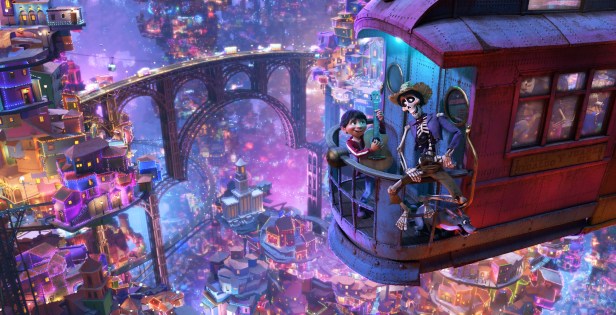
Is loving Coco‘s message of storying our relation to those who gave us life a 47-year-old’s crisis, Pixar instead of Porsches and perversion? Is being glad for the lit-crit thriving of Turtles? Is reveling in the new Star Wars saga that should be my birthright by, once again, the contingency of my chronology? This is, after all, an entry in a blog about my music and film loves, so I’ll just go ahead and offer this, what the hell:
Forget the past–kill it if you have to –Rian Johnson, Star Wars: The Last Jedi
and juxtapose it with this:
Imagining the future is a kind of nostalgia –John Green, Looking for Alaska
Both quotes capture something and each misses the mark, too, another paradox, this one of language. Yes, our pasts must give birth to us and die in the passage, but we always bear them, too. Yes, the horizons we can see are circumscribed narrowly by our having yearned for them, but the present fires with purpose only when stoked by a particular reach for a future, too.
What we once thought we had we didn’t and what we have now will never be that way again…Who is this great burdensome slavering dog-thing that mediocres my every thought? I feel like a vacuum, a complete sucker –Nick Cave, “We Call Upon the Author to Explain”
The paradox of the self that creates itself floods through our life and our language–Schrag calls this “hermeneutic self-implicature,” which is deadly dull, sure, but even when I first read Schrag I preferred the metaphor (I’m pretty sure I made this metaphor up when we discussed Schrag in our grad seminar) of “the hurricane self” because like the eye of the hurricane, the I of language is an empty center around which a furor of activity shapes an absence into the most precise, real-seeming part of the storm’s whole vector. The idea [I-dea] is that the person “I” is not thinkable or knowable at all in any legitimate sense except as that person is entailed by language; the “I” is each of us who speaks ourselves into being by predicating acts and claims and thoughts and attributing these, in a structure of elaborately intertwined sayings-so, to someone we come to see as responsible, “I,” as the agent of this structure, as the cruel author Green from whom Aza Holmes demands an answer to The Question of her pain, the question that Hannah Arendt and Elaine Scarry taught us cannot be answered because language fails us most fully when we grapple with pain, the most solipsistic barrier in human experience, and of course it’s women who know this better than anyone because the turtles must make it all the way down to the sea.
Today, as I write this, would have been my mother’s 68th birthday. The greatest birthdate ever, in my view: January 1, 1950. The Avatar of the 20th century’s second half, no doubt born in time: a screaming teen mad for The Beatles, a Jew who embraced evangelical Jesus, a single mom struggling 500 miles from her home, the White driver of a robin’s-egg-blue Volkswagen Beetle with a salon-coiffed afro.
Sara Ahmed calls them “lines of orientation,” the deep grooves we make in our experiential landscapes through repetition, lines that form and reform and deform our loves and likes and expectations and over time appear to us as “the way the world is,” just as we appear to ourselves over time as “I.” Literature is supposed to soften, loosen these lines, which is why I worry about the tightening spiral of John Green. But a third paradox: I learn about lines of orientation from Green, too, because his stories are stories of how these lines get thickened, how the grooves etch the mirror of the self. This is what makes art great, for me, often. Green achieves this; the films of the Coen brothers often do, too. Noah Hawley’s Fargo tv series may do this even better than his forebears the Coens: in Hawley and in Green characters’ choices not only pivot the plot but precisely, prominently, perceptibly produce the particular person–almost, but not quite, trapped also within whirlpools of context, in book after book, in scene after scene.
I’m not that good at breathing in –Courtney Barnett, “Avant Gardener”
I read young adult literature and wonder how to recapture my ability to live beyond the terrifying eye/I. I struggle to remember what I can see and do well. “I” was once possibility and now, the grooves deep, the lines etched in the mirror, I look like lapsed promises. One act I still find I may do effectively is synthesize ideas; I love to bring the wild, whipping arms of the storm into view in the eye–singing (if only I could sing) out the resonances among Turtles and Coco and The Last Jedi and Australian musician-poets and sundry philosophers. I think it makes me a better teacher, this ability. I also think it makes me crazy, sometimes, because the connections feel so dangerously, achingly near yet out of reach, not articulable, the waves too far down for my feeble shell to find.
I also think it makes me a better listener. Bob Dylan is so good with beaches it’s impossible to understand how he grew up in the plains just under the Canadian border. My favorite verse of all is the last one in “Mr. Tambourine Man,” beach become the beautiful business of being born and borne out of time. Exactly like that, yes. But “Every Grain of Sand” takes me back there again, and I feel that feeling exactly too: sometimes there’s someone (or something) there, something I can believe in, something I can love about life and language, something that feels like a future. Other times it’s only me.
 Selling Dust
“When I try to think of something that you’ve never heard, there are no words.” – No Words, by The Script
Thank you for sharing (and tagging) me bro!